Tibyan Toolkit 03
Choose one skill to develop
Build a focused development priority in 15 minutes.
PDF · 8 pages · 113 KB · Version 1
Download English PDFMap role-specific sales tasks, shared learning and handoffs, then define evidence for supported progression.

The same discovery workshop can ask a prospecting specialist to investigate technical details they do not own, while giving an experienced account executive practice they have already mastered. The course may be accurate and still allocate learning poorly. A useful pathway connects learning to the tasks a person owns and the evidence needed before they work more independently.
This guide helps sales leaders and learning designers build a role–task–behavior matrix and a supported progression plan. Bring actual role descriptions, a recent customer handoff, examples of acceptable work, and the authority limits that govern customer commitments. Start with one shared task across roles rather than the entire sales curriculum.
Hypothetical teaching case: a regional B2B services company prepares proposals for multi-site implementations. Some proposals leave requirements and responsibilities unresolved. Sales, learning, and delivery are designing a response together. This fictional company and all pathway examples below illustrate decisions; no client results are reported.
The customer needs to understand what is proposed, what remains uncertain, and who will verify the dependencies. Several employees contribute to that decision. The person making initial contact might recognize an implementation concern and route it. The account executive might clarify the requirement. A specialist might verify feasibility. The manager might check whether the handoff works.
These are proposed allocations for this case. Titles such as SDR, account executive, or solution engineer vary between organizations. Inspect actual work and responsibility before attaching a pathway to a label.
CIPD connects needs analysis with current and future capability and organizational priorities. Its guidance supports investigating the work before selecting learning. The pathway method here is Tibyan’s adaptation. CIPD: Learning needs analysis.
Everyone in the example needs to distinguish customer facts from assumptions. That shared principle does not mean everyone should produce the same output or answer every technical question.
| Role in this case | Required task | Observable evidence |
|---|---|---|
| Initial qualification | Recognize a relevant dependency and route the question | Accurate handoff note, uncertainty and receiving owner |
| Account executive | Clarify needs and preserve unknowns before proposing scope | Requirements summary with verification actions |
| Technical or delivery specialist | Assess feasibility within their authority | Qualified answer, conditions and unresolved risks |
| Sales manager | Review readiness and support the next action | Evidence-based review and agreed support |
The manager resolves overlaps and authority. The designer identifies the component skills in each task. Delivery checks that the proposed handoff contains enough information to act. A matrix that merely repeats the same competency under every role has not yet made these decisions.
For example, “commercial awareness” is too broad to determine practice. “Explain which unresolved requirement prevents a firm scope commitment” is observable and can be discussed against examples.
Write a performance outcome with the situation, action and quality criteria. For the account executive: given a fictional buyer conversation and the approved guide, produce a summary separating confirmed requirements, assumptions and verification actions, without representing an unverified dependency as agreed scope.
For the qualification role, reduce technical responsibility while keeping accuracy: given an inbound brief, identify the implementation concern, capture the buyer’s wording and route it to the appropriate colleague. Do not require that person to validate feasibility outside their authority.
Carnegie Mellon’s Eberly Center explains alignment among learning objectives, assessment and instructional strategies. This course-design principle informs our role-specific examples; it does not demonstrate a sales result. Eberly Center: Learning objectives.
Decide which tools are available during the task. If the actual job requires a requirements guide, train and assess its use. If a seller must retrieve a critical escalation rule without reference, explain why that requirement is necessary and give them an opportunity to learn it.
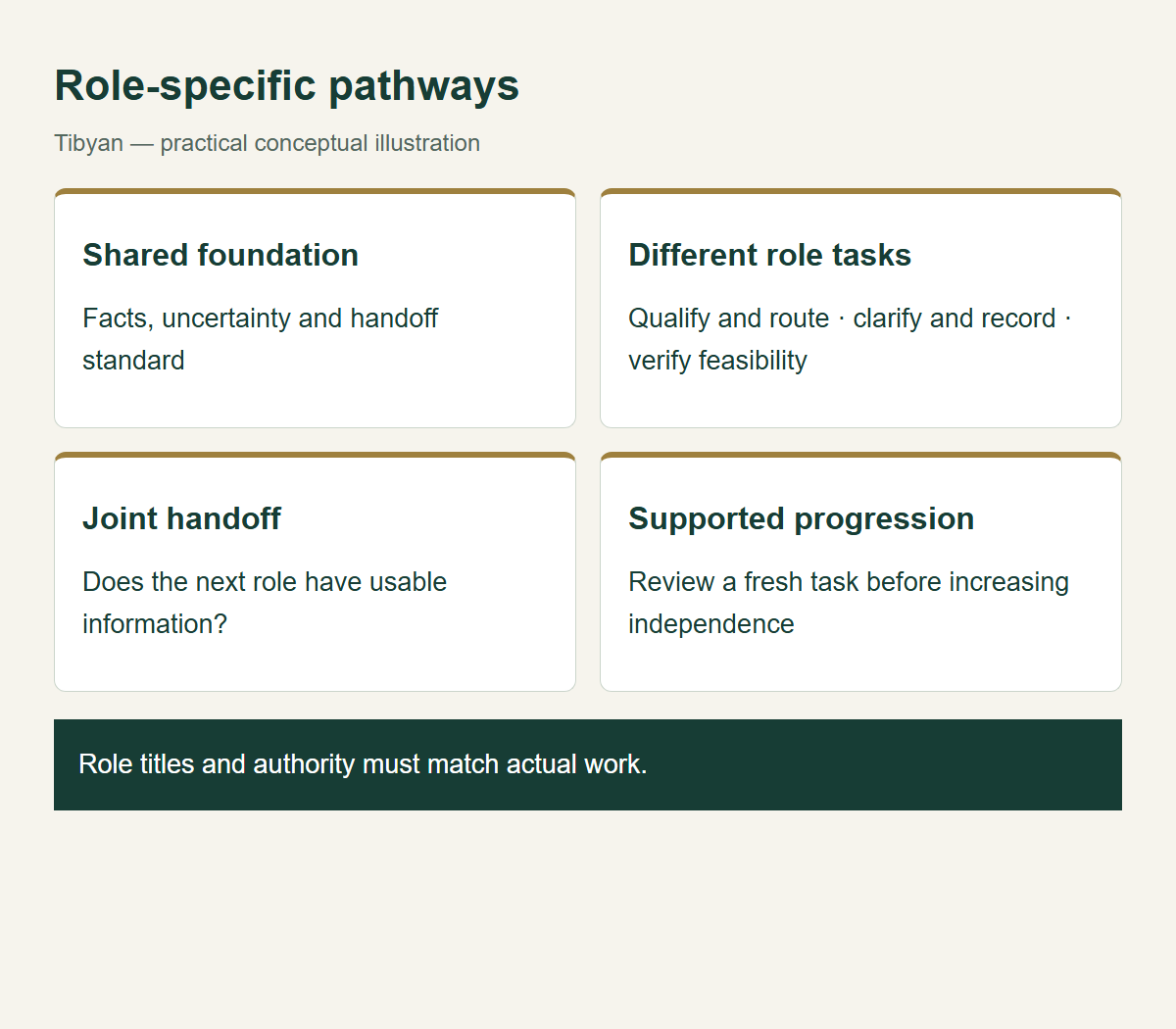
Tibyan recommends a short common foundation covering terminology, customer facts, uncertainty and the handoff standard. Then branch into the work each role must perform. Reconnect the pathways in a joint handoff exercise so participants can see how their outputs affect colleagues.
 Open the diagram full size ↗
Tibyan conceptual pathway. Sequence and progression criteria are proposed design choices to test with the relevant roles.
The qualification branch might practise recognizing a dependency in an incomplete brief. The account-executive branch practises clarifying and recording it. The specialist branch practises a qualified feasibility response. Managers practise reviewing evidence and distinguishing a capability problem from an unanswered specialist request.
Choose the delivery format after specifying the interaction. A reference explanation may suit independent study; a judgment requiring another person’s response needs dialogue or simulation. Sharing an online module does not create shared understanding of the handoff on its own.
An experienced seller may need a short diagnostic task rather than every introductory activity. A new specialist may understand implementation well but need practice expressing uncertainty for a commercial audience. Tenure, confidence and title are useful context, not direct demonstrations of the target task.
Offer a fair diagnostic route using comparable instructions and criteria. Explain what evidence would allow someone to bypass introductory practice and what support remains available. If a learner lacks the required prerequisite, provide it before the more complex assessment.
CIPD’s public introduction to competency frameworks stresses clarity of expectations while cautioning against excessive prescription. We use that limited guidance to support a matrix that can adapt to local work. The full member-only factsheet was not used here. CIPD: Competency frameworks.
Agree what changes after each demonstration. A seller may first observe a worked example, then complete a supported task, then handle a fresh simulation independently, and finally apply the skill to suitable work under review. These are suggested stages, not a universal certification model.
Keep responsibility proportional to demonstrated competence and the consequence of error. Passing a simulation about documenting unknowns does not authorize the seller to promise technical feasibility. Separate learning evidence from the organization’s formal approval authority.
Record assistance as well as task quality. A complete summary produced after extensive prompting is different evidence from an independently produced summary. Both can inform development, but they should not silently receive the same interpretation.
Complete one row for one role and task. Keep the first version small enough to review with the people doing and receiving the work.
| Field | Your entry |
|---|---|
| Customer decision | Which decision does this work support? |
| Role and authority | Who performs the task, and what can they commit to? |
| Task and conditions | What must they do, with which information and tools? |
| Evidence | What output or observation shows acceptable performance? |
| Practice and support | What attempt, feedback and reference aid are needed? |
| Progression decision | What responsibility can increase after review? |
| Reviewer and next sample | Who checks which fresh task or work sample? |
Illustrative completed entry: an initial qualification colleague receives a buyer’s message about a multi-site rollout. The learning task is to preserve the concern about data preparation and route it, not to resolve the technical question. Acceptable evidence is an accurate note identifying what remains unknown and who receives it. The designer builds contrasting incomplete briefs; the manager confirms routing access. The next reviewer is the account executive receiving a fresh handoff.
The annotation matters: the standard measures usefulness to the next role. A note with every field completed using guesses would fail that purpose. A note stating that ownership is unknown and assigning a verification step could be useful even before the final answer exists.
Run one joint exercise. Give the first participant the buyer’s initial brief. Ask each role to produce its output using only the information it would normally receive. Let the receiving role explain what it can act on and what it still needs.
The designer observes where the task or instructions cause confusion. The manager identifies unresolved ownership. The specialist checks technical accuracy. Revise the handoff standard before adding more modules when the failure occurs between roles.
Use fictional or appropriately anonymized information. Check language and terminology against the actual systems: an Arabic learning activity can become confusing if the working CRM uses different English field names without explanation.
Select one weak connection, write the required behavior, and agree a supported attempt. Review the next suitable work sample with the receiving colleague. If no appropriate opportunity occurs, record that limitation and arrange a later review or protected practice.
The pathway is ready to pilot when every branch has an owned task, a useful output, clear authority, and an evidence-based progression decision. Completion rates can help administer it; quality and application evidence determine what to improve.
Use Choose one skill to develop to focus the first development priority, then add the role, handoff and progression fields above. For an onboarding application, see Build a 30–60–90-Day Sales Onboarding Plan Around Real Work.
Cover: AI-generated conceptual illustration. Pathways, matrix and fictional examples are Tibyan recommendations without empirical validation claimed.
Sources checked November 2, 2026. Role allocations and progression rules are illustrative design choices, not industry-wide job definitions.
Take the next step
Free downloads. No registration. Each PDF includes instructions, an illustrative example and a reusable worksheet.
Tibyan Toolkit 03
Build a focused development priority in 15 minutes.
PDF · 8 pages · 113 KB · Version 1
Download English PDFPractical worksheets, not validated assessments. Adapt the task and timing to your context. See each PDF for its revision date.
Explore the tools & toolkits library ↗
Practical perspective
Prepare a B2B quotation that procurement, finance, and operations can assess. Use Tibyan’s QUOTE Framework, an annotated example, and a 13-point checklist.
Read perspective
Talent Development
Check whether the task still matters, how people learn it and what gets in their way before you keep, redesign or retire a course.
Read perspective
Team development
Follow one customer case across teams and find which handoff lost the facts, ownership or promise.
Read perspective