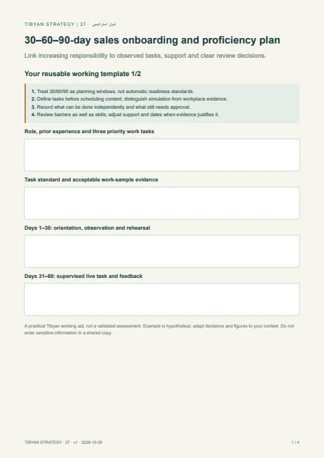
Tibyan Toolkit 27
30–60–90-day sales onboarding and proficiency plan
Link increasing responsibility to observed tasks, support and clear review decisions.
PDF · 4 pages · 67 KB · Version 1
Download English PDF Open editable working template ↗Replace a calendar of introductions and product modules with a supervised path to useful sales work, clear evidence and role-specific independence.

A new salesperson completes every module, can describe the product and has met the leadership team. Yet their first discovery call produces vague notes, and their proposal promises a delivery date that nobody has checked. The onboarding calendar is complete; readiness for the work is not.
A useful onboarding plan connects learning to tasks the person must perform, the conditions in which they will perform them and the evidence a manager needs before increasing independence. It also gives the new colleague access, relationships and support. Training cannot compensate for a missing system account or an unavailable delivery contact.
Learning outcome: build an onboarding plan that moves from observation to supervised practice and bounded independence, using specific work samples and review decisions.
The dates in this guide are convenient review windows, not a universal standard for sales competence. A new graduate selling complex services and an experienced account manager joining a familiar market need different support. A sales cycle may also extend well beyond ninety days.
Use the dates to ask what useful work is becoming possible and what remains unsupported. Do not make calendar passage the reason to release someone into unsupervised customer commitments. Nor should a long sales cycle prevent the employee from demonstrating specific early tasks.
CIPD's induction guidance includes the organization, people and team, and role expectations among the information new starters need. That supports a broad onboarding view; the task progression below is Tibyan's practical design. CIPD: employee induction.
List the work the person is expected to own. For a B2B account executive, it may include selecting suitable accounts, preparing a discovery conversation, recording buyer evidence, qualifying an opportunity, developing a proposal and coordinating delivery review. A business-development role may stop before proposal ownership.
Choose a small set of important tasks and define an acceptable example. “Understands discovery” is too broad. “Conducts a supervised discovery conversation, separates confirmed information from assumptions and agrees a useful next evidence step” provides something to observe.
Use existing work, with permission and appropriate confidentiality controls, to illustrate standards. Include a strong sample and a sample needing improvement. Explain why they differ. If the team cannot agree what adequate work looks like, resolve that before asking a newcomer to infer it.
| Planning window | Main emphasis | Example task | Evidence and decision |
|---|---|---|---|
| Days 1–30 | Orient, observe and rehearse | Prepare a target-account brief and practice discovery | Manager checks facts, customer relevance and questioning |
| Days 31–60 | Perform with supervision | Lead a bounded discovery call and write the summary | Review actual notes, buyer corrections and next step |
| Days 61–90 | Own selected work with clear boundaries | Manage a suitable opportunity through an agreed stage | Inspect evidence, handover and escalation judgment |
This table is illustrative. Move tasks earlier or later when prior experience, opportunity availability or risk justifies it. The phase should specify what the person can do independently, what requires review and what remains outside their authority.
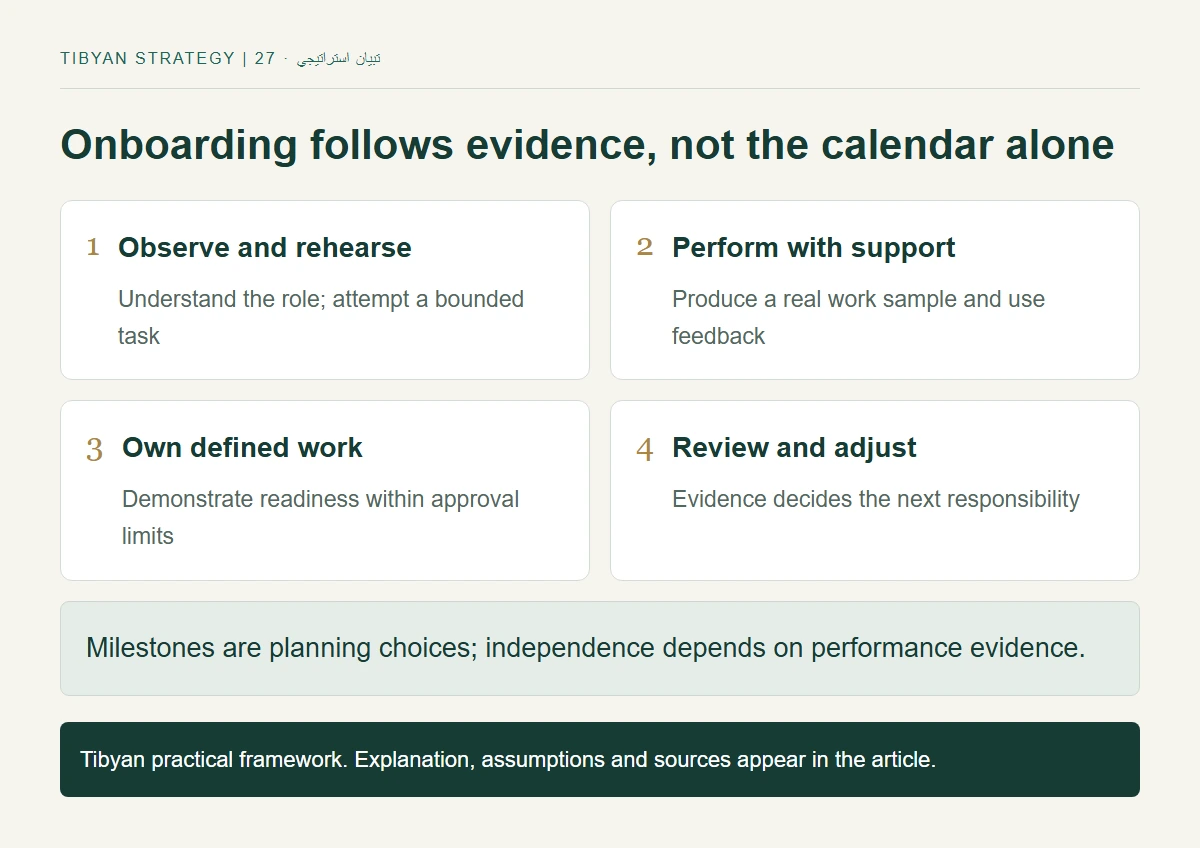 Open the diagram full size ↗
Conceptual diagram: Tibyan's onboarding progression. Review dates organize support; demonstrated readiness determines the next responsibility.
Before the employee starts, name the manager, buddy and specialists who will support important tasks. Confirm access to systems, approved templates, product information, relevant policies and customer examples. Explain the route for asking for help.
Avoid scheduling a crowded first week that leaves no space to digest or attempt the work. Pair a short explanation with observation, rehearsal and feedback. The new colleague might observe one discovery call with a clear question to notice, then prepare part of the next call and rehearse it with the manager.
The buddy can explain everyday ways of working; the manager remains responsible for performance expectations and review decisions. Specialists should clarify technical or delivery boundaries. Do not assume that an informal buddy relationship covers authorization to make customer commitments.
Tibyan suggests four review descriptions: not yet attempted, demonstrated in practice, demonstrated with supervision and demonstrated independently within agreed boundaries. These are working labels, not a validated certification scale.
For each task, record the work sample, context, observed behavior, support provided and next step. A single good rehearsal does not establish independent workplace performance. Equally, lack of a live opportunity is not evidence that the employee cannot perform.
If a task has not arisen, provide an appropriate simulation and record its limits. Schedule a later live observation when feasible. Keep the distinction between practiced readiness and demonstrated workplace application visible.
A maintenance-analytics supplier hires an experienced salesperson who is new to industrial customers. The employee can negotiate confidently but has little experience with production-data dependencies. The manager chooses three early tasks: create an evidence-backed account brief, conduct discovery and prepare a delivery-ready proposal outline.
In the first window, the employee observes calls with maintenance and operations contacts, rehearses follow-up questions and practices identifying facts versus assumptions. The work sample is an account brief with sources and open questions. Product quizzes support preparation but do not stand in for this task.
In the second window, the employee leads a discovery call while the manager observes. The resulting summary identifies the problem owner, unverified production impact, data-access question and buyer-agreed next step. Feedback targets one missed opportunity to explore a consequence.
In the third window, the employee owns a suitable opportunity's next-stage work but must obtain delivery approval before promising integration dates. A technical specialist checks the proposal assumptions. The review confirms which work can now proceed independently and what still needs support.
This is a fictional teaching example. It does not imply that everyone should meet these milestones by these dates, or that completing the plan guarantees revenue.
At each checkpoint, ask the employee to bring a work sample and explain their reasoning. Compare it with the agreed task standard. Discuss what they attempted, what happened, what support they used and what they would change.
Choose a concrete decision: maintain the current supervision, increase independence for a defined task, provide further practice or remove a workplace barrier. Write the next action and review date. Where a system or resource problem prevents performance, assign the issue to its owner rather than recording an individual skill failure.
The 2026 US Government Accountability Office training guide treats planning, design, implementation and evaluation as an integrated cycle, with evaluation informing earlier decisions. Its federal-government context differs from a sales team; here it supports treating review as ongoing improvement. GAO: strategic training and development guide.
For that last distinction, use the sales skill-gap or system-problem guide.
Select one role and three important tasks. Define the evidence for each, identify safe practice opportunities and name a reviewer. Put the 30–60–90 checkpoints around those tasks, then adapt the dates to the actual work.
Download the free sales onboarding and proficiency plan.
For help choosing the practice, revisit building a sales curriculum from work tasks. Keep the plan usable enough that a manager and new colleague can review it together.
You can also use the editable, printable working template. Download an edited copy from your browser without submitting your entries.
Explore the Sales Training collection.
Cover: AI-generated conceptual artwork. Diagram and tool: original Tibyan editorial design.
Take the next step
Free downloads. No registration. Each PDF includes instructions, an illustrative example and a reusable worksheet.
Tibyan Toolkit 27
Link increasing responsibility to observed tasks, support and clear review decisions.
PDF · 4 pages · 67 KB · Version 1
Download English PDF Open editable working template ↗Practical worksheets, not validated assessments. Adapt the task and timing to your context. See each PDF for its revision date.
Explore the tools & toolkits library ↗
Practical perspective
Prepare a B2B quotation that procurement, finance, and operations can assess. Use Tibyan’s QUOTE Framework, an annotated example, and a 13-point checklist.
Read perspective
Talent Development
Check whether the task still matters, how people learn it and what gets in their way before you keep, redesign or retire a course.
Read perspective
Team development
Follow one customer case across teams and find which handoff lost the facts, ownership or promise.
Read perspective