Imagine a colleague says, “I can’t get proposals out on time.” You could suggest a planning tool. First ask, “Can you walk me through the last proposal that went out late?” A specific example might show that an estimate arrived after the deadline. It might show that the estimate arrived on time and the work stalled later.
A useful follow-up starts with a detail you actually heard. Let the person finish. Pick a detail that could change your understanding, then check what you think it means. Try this on a low-stakes topic with a willing colleague and agree what you want to understand.
Separate what happened from what it might mean
Separate what happened from how the person interprets it. “The approver returned the file” describes an event. “The approver does not trust us” is an interpretation. Both may matter, but they require different follow-ups: what was returned, what reason was given and what led the speaker to infer distrust?
The International Coaching Federation’s competencies call for listening in context and checking understanding by reflecting or summarizing what someone said. Applied to a workplace conversation, that means asking what happened and checking whether you understood how the speaker interpreted it. ICF Core Competencies, 2025.
 Open the diagram full size ↗
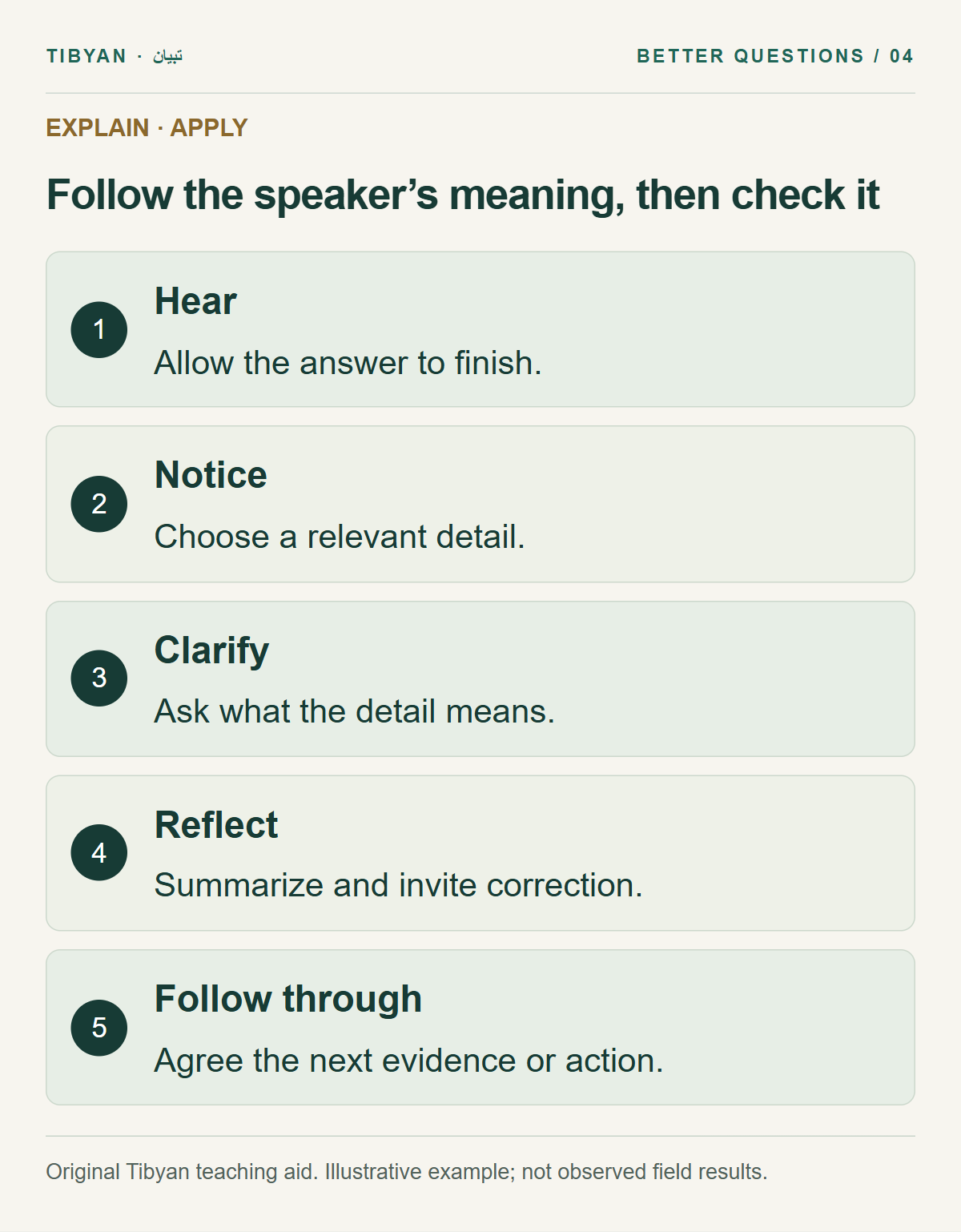
Use a detail from the speaker’s answer to choose the next question. Check a summary before turning it into a next action.
- Follow the speaker’s meaning, then check it
- 1. Hear
- Allow the answer to finish.
- 2. Notice
- Choose a relevant detail.
- 3. Clarify
- Ask what the detail means.
- 4. Reflect
- Summarize and invite correction.
- 5. Follow through
- Agree the next evidence or action.
- Original Tibyan teaching aid. Illustrative example; not observed field results.
Ask a follow-up that earns its place
Ask what an unclear word means: “When you say the file was complete, what was in it?” If timing matters, ask what happened after the file was sent. To check your reading, try “Have I understood you correctly? The delay began before the approver saw the file?” If the speaker describes a pattern, ask when the handoff went well and what was different.
Avoid asking for every detail. Choose the next question for its relevance to the agreed purpose. If the conversation moves into something sensitive or outside that purpose, explain why you are asking and allow the person to decline or redirect. Do not infer feelings or motives as facts from a gesture or tone; check your interpretation respectfully.
Give people room to disagree
When an answer challenges your view, ask which example led the speaker to that conclusion. Say what you already know and how you will use what they tell you. Give them time to add a detail or correct your reading before you respond.
In Edmondson’s study of 51 teams at one manufacturing company, psychological safety was associated with learning behavior. For a manager, one practical place to pay attention is the moment a colleague corrects them. The study examined a team-level association. It did not test this conversation technique. Edmondson, 1999.
Check the summary before agreeing what to do
Summarize what happened, how the speaker understands it and what still needs checking. Ask them to correct your summary. Agree what each person will do next, and record any disagreement that still matters to the decision.
 Open the diagram full size ↗
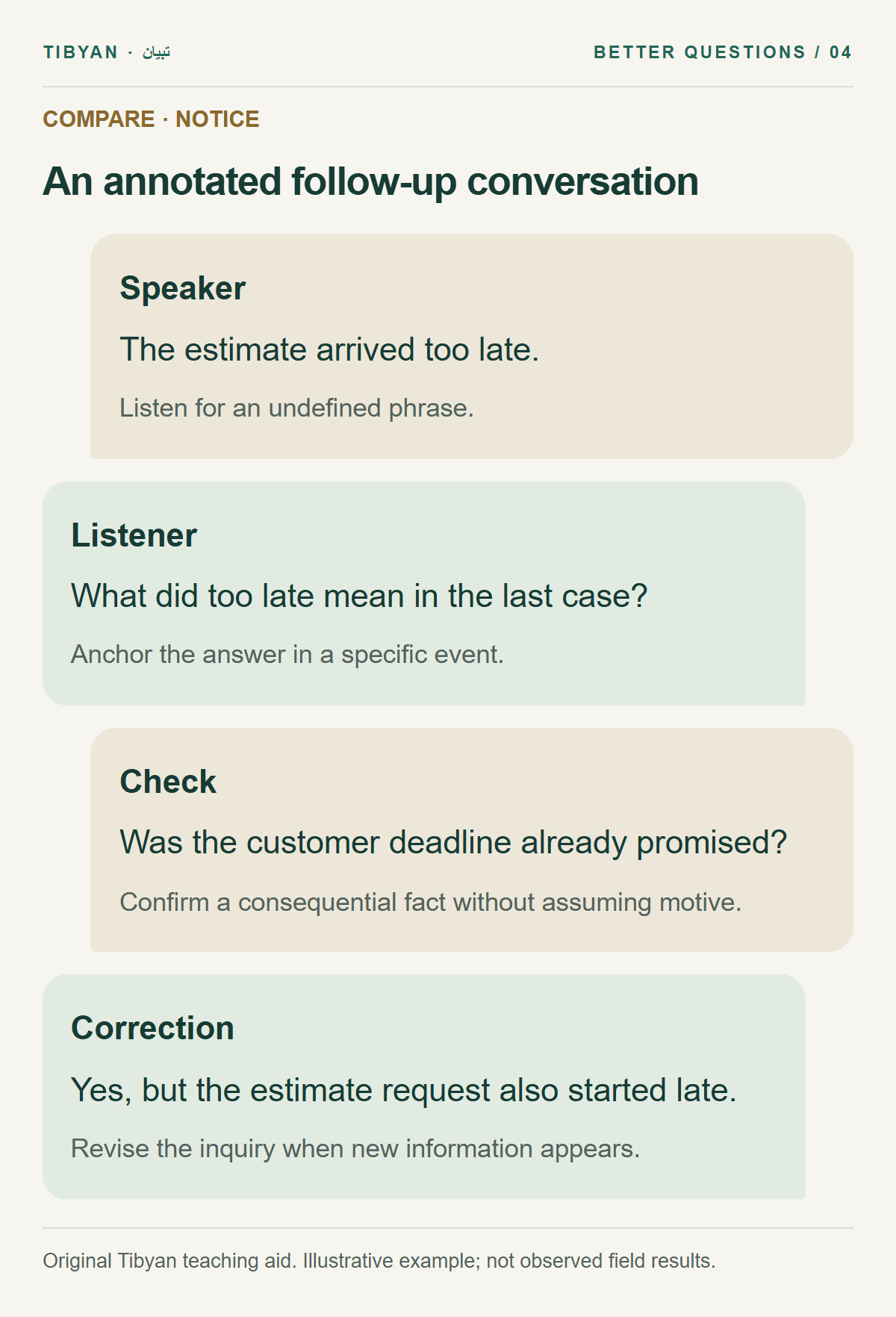
The important turn is the correction. A listener’s plausible summary stays provisional until the speaker has a chance to amend it.
- An annotated follow-up conversation
- Speaker
- The estimate arrived too late.
- Listen for an undefined phrase.
- Listener
- What did too late mean in the last case?
- Anchor the answer in a specific event.
- Check
- Was the customer deadline already promised?
- Confirm a consequential fact without assuming motive.
- Correction
- Yes, but the estimate request also started late.
- Revise the inquiry when new information appears.
- Original Tibyan teaching aid. Illustrative example; not observed field results.
Follow one conversation as the account changes
Fictional practice dialogue. Huda and a colleague walk through proposal P3. They agree to use brief notes for feedback on the conversation and to leave out unrelated personal information.
Read Huda's first line, pause and write your own follow-up before reading the remaining turns.
The change is in what the listener does after the correction. They follow up on the new scope, revise the summary and agree what record would help check it.
Practice with explicit roles
Work in triads: speaker, listener and observer. Use three seven-minute rounds so everyone takes each role: four minutes of conversation, two minutes of evidence-based feedback and one minute to retry a missed follow-up. Allow 21 minutes for the full rotation; in a shorter lesson, complete one round and schedule the remaining rotations. The speaker uses a routine, non-sensitive difficulty. The observer records a statement, the resulting follow-up and whether the speaker corrected the summary.
Use the worksheet to capture what changed
Open the editable working tool · Download the printable pack
- Purpose and recording agreement: Name the task, participants and use of notes.
- Observation row 1: Speaker statement | listener response | relevance or correction.
- Observation row 2: Repeat the row for a summary and the speaker’s correction.
- Observation row 3: Repeat the row for the next answer-dependent follow-up.
- Missed opportunity and retry: Quote the missed cue and a better next turn.
- Checked summary and disagreement: Record what is heard accurately and what is still uncertain.
- Owned next check: Specify the next artifact, person and opportunity.
- Next application and feedback: Record one chosen listening behavior and how it will be examined.
Independent-study alternative
Cover turns 5–7. After turn 4, write a tentative summary and what could be missing. Reveal the correction, write a new follow-up, then compare it with the model. Explain which detail caused you to revise.
Check your work
- Did each follow-up come from something the speaker said?
- Can you tell what happened and what the speaker inferred?
- What did the speaker correct in your summary?
- Did that correction change the next check or action?
Apply and review
When someone next says a task was “late,” ask which deadline they mean and walk through one instance. Summarize what you heard, leave room for a correction and note what that correction changes about the next step.
Continue the learning route
Previous: Questions That Improve Learning and Critical Thinking · Series overview · Next: Questions for Leadership, Coaching, and Team Learning
Sources and further reading