Tibyan Toolkit 32
Buyer-Experience Localization Audit
Find what prevents one buyer task from working, assign the repair and test it with the intended users.
PDF · 8 pages · 74 KB · Version 1
Download English PDF Open editable working template ↗Audit buyer proof, proposals, request paths and support promises. Use a practical localization tool to prioritize gaps and plan reader testing.

Your Arabic brochure reads well. The demonstration request still assumes a foreign address format, the confirmation arrives only in English and the proposal promises local support that operations has not approved. The content has been translated, but the buyer's work remains difficult—and one attractive sentence may have created a commitment you cannot deliver.
Localization becomes commercially useful when a particular buying group can understand the offer, inspect relevant evidence, complete its next task and receive the service that was promised. Begin with that task rather than a list of documents to translate.
Use this guide when: you are adapting a defined B2B offer for a country–customer segment and need to decide which buyer-facing gaps to correct first.
Learning outcome: build a prioritized buying-experience audit, assign owners and design a task-based check of the proposed improvements.
Bring: current pages, proposals, demonstrations and support instructions; approved claims and delivery limits; the buying roles and language needs you have evidence for. If the selling arrangement remains unclear, first review your route to market.
“Make our website Arabic” describes an output. “Help a technical evaluator identify the installation scope and request a relevant demonstration” describes work the experience must support. The second statement gives your team a basis for judging whether the change is useful.
W3C defines localization as adaptation to a particular locale and explains that it extends beyond translation to matters such as formats and script readability. This is a technical definition, not evidence of a conversion increase. W3C: Localization vs. Internationalization.
Tibyan recommends documenting four things: the buyer role, the decision or task, the material used and the observable output. For example, an evaluator may need to compare technical requirements, while procurement needs to understand the contracting party and excluded services. Do not assume they need the same page or proof.
Confirm those needs with appropriate people. Country, sector, organization size, role and task can all matter; an Arabic-speaking market is not a single buyer persona. Treat an unverified preference as a question for investigation, not a design rule.
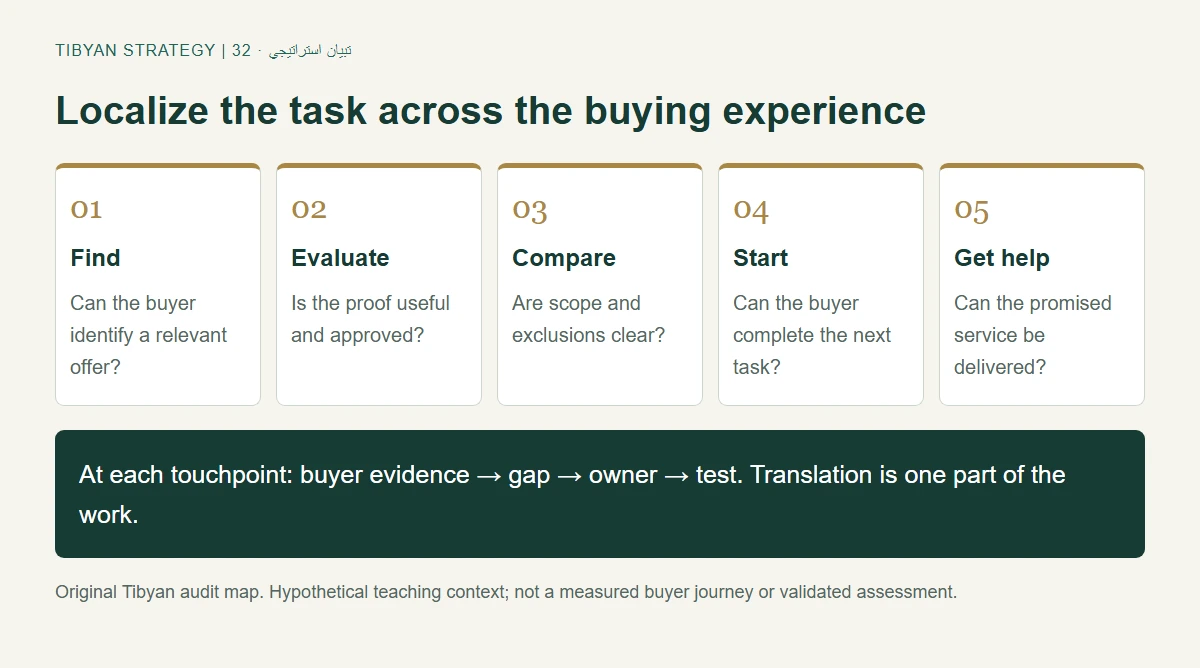
A beautifully translated page cannot compensate for a failed next step. Follow the buyer's intended path from first interest through evaluation, approval, onboarding and support. You need not redesign every touchpoint at once; inspect the dependencies of the task you selected.
| Touchpoint | Task to investigate | Evidence or material to inspect |
|---|---|---|
| Find the offer | Recognize whether it addresses the relevant problem | Landing page, terminology and navigation |
| Evaluate proof | Judge whether the claims fit the buyer's situation | Demonstration, source-backed evidence and limitations |
| Compare and approve | Understand scope, responsibilities and commercial conditions | Proposal, exclusions, acceptance and contracting information |
| Buy and onboard | Complete the agreed purchasing and startup steps | Forms, confirmation, handover and onboarding instructions |
| Use and get help | Find usable guidance and reach the right support owner | Help content, contact path, coverage and escalation |
Canada's Trade Commissioner Service recommends adapting language, channels and buyer-facing content, including review for local fit beyond language accuracy. The audit below is Tibyan's application of export guidance, not a validated sales method. TCS: Marketing and sales.
For each step, record what you actually inspected. “Arabic available” is less useful than “the Arabic page opens, but its demonstration button leads to an English-only form.” Name the source version and the unresolved dependency so someone can reproduce the issue.
 Open the diagram full size ↗
Original Tibyan audit map. The sequence helps inspect a proposed buying experience; it is not an observed customer journey or a universal buying process.
Different problems need different owners. A translator cannot approve a service commitment; a designer cannot supply missing customer evidence. Distinguish these categories before estimating the work.
| Gap | Example of what to check | Appropriate response |
|---|---|---|
| Language and meaning | A term is grammatically correct but unclear in the buyer's task | Review terminology with a relevant bilingual practitioner |
| Evidence | A savings statement has no traceable basis | Supply qualified evidence, narrow the claim or remove it |
| Format and interaction | Required fields cannot accept the user's legitimate details | Correct the field rules and test completion |
| Workflow | A request arrives, but no owner confirms the next step | Assign routing, confirmation and responsibility |
| Delivery promise | “Local support” does not specify coverage or a capable owner | Define an approved service scope before presenting it |
Look especially closely at mixed-direction material: product codes, quantities, prices, dates, telephone numbers and links inside Arabic text. Correct shaping alone does not guarantee that a reader interprets the sequence correctly. Use unambiguous labels and test the actual document or screen, including on mobile. A proposed change must preserve the same underlying offer, calculations and limitations in both editions.
This is an invented teaching example. All companies, buyer needs and decisions are hypothetical; no client result or country-wide requirement is claimed. An industrial-monitoring supplier is preparing a package for private manufacturers in a defined Saudi segment. Its brochure says “24/7 local support.” The team cannot identify an approved coverage roster or escalation agreement. The demonstration form also uses an unsuitable mandatory address pattern, and the confirmation is English-only.
The appropriate response is not to polish the support sentence. Operations must clarify what service can actually be delivered, by whom and under which conditions. Until then, remove or qualify the claim. Marketing and the technical owner can repair the form and confirmation path without pretending that this resolves service readiness.
Weak conclusion: “The brochure is in Arabic, so localization is complete.”
Better conclusion: “We have translated the brochure. The request path needs correction, and the support scope remains unapproved. We will test whether a likely evaluator can find relevant proof, identify installation scope and request a demonstration in the task language before widening use.”
No usability session has occurred in this example. “We will test” is a plan, not a finding. If readers later perform the task successfully, that would support a claim about the observed task under the test conditions. It would not establish that the adaptation caused higher sales.
Tibyan suggests three working priorities: correct before wider use, test a proposed improvement, or refine later. These are editorial decision labels, not a standardized severity scale.
Correct a material unsupported promise or a step that blocks the intended task before expanding exposure. Test a plausible change when its value depends on how readers interpret or use it. Defer cosmetic changes when more consequential uncertainty remains.
For each action, write the problem, consequence, evidence, owner and completion check. “Improve the proposal” has no clear endpoint. “Separate included installation work from excluded site preparation, obtain delivery approval and check that an evaluator can locate both” does.
Maintain a decision log when the change affects scope. A clearer phrase can expose a disagreement about the offer rather than solve it. Escalate that disagreement; do not allow the localized edition to become a different commercial promise by accident.
GOV.UK's usability guidance describes observing actual or likely users attempting specific tasks to uncover problems. Applying that practice to a B2B proposal or request path is an adaptation of service-design guidance. GOV.UK: Moderated usability testing.
Choose a realistic task without giving away the answer. “Find the exclusion paragraph” tests recognition of your wording. “What work would your organization need to arrange before installation?” tests whether the document supports a useful interpretation. Explain the test, obtain appropriate permission and avoid requiring sensitive customer information.
Observe what the participant does before explaining the material. Record completion, assistance, interpretation errors and the evidence behind your judgment. If you record time, explain why it matters; speed is not automatically the goal of careful technical evaluation.
Test Arabic and English versions separately with relevant readers. Equivalent wording does not prove equivalent usability. Keep participant roles, materials, versions and conditions visible, and record unsuccessful attempts as well as successful ones. A small formative check identifies issues; it is not a representative market study.
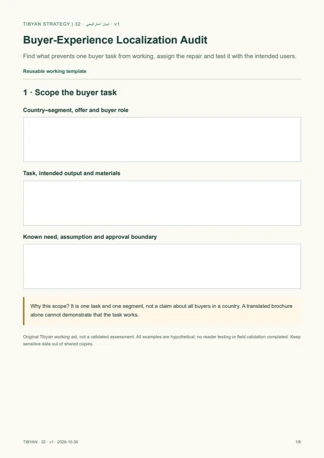
Use the free Buyer-Experience Localization Audit (PDF) to map the task, identify gaps, assign owners and plan a reader check. The working pack includes blank pages and a completed hypothetical example with annotations. Start with one consequential task and the materials it depends on; expand after you have learned from the first review.
You can also use the editable, printable working pack and download your edited copy.
Before meeting readers, ask sales, delivery and a relevant bilingual reviewer to inspect the scope and claims. Record what they actually reviewed and what remains unresolved. Do not label the experience “buyer-tested” before a test has occurred.
If the audit exposes an unresolved relationship between what you promise and what your team can deliver, you can discuss your situation with Tibyan. For operating responsibilities, use the delivery readiness guide.
The sources provide definitions and professional guidance. The audit, priorities and example are original Tibyan teaching aids, not field-validated instruments. Permissioned buyer observations, intended-reader testing in both languages and independent practitioner/bilingual review are still needed. No actual customer evidence, conversion lift or revenue impact is claimed.
Cover: original AI-generated conceptual artwork. Diagram and working pack: original Tibyan editorial designs.
Related free resource: supporting working tool.
Sources checked 30 October 2026.
Take the next step
Free downloads. No registration. Each PDF includes instructions, an illustrative example and a reusable worksheet.
Tibyan Toolkit 32
Find what prevents one buyer task from working, assign the repair and test it with the intended users.
PDF · 8 pages · 74 KB · Version 1
Download English PDF Open editable working template ↗Practical worksheets, not validated assessments. Adapt the task and timing to your context. See each PDF for its revision date.
Explore the tools & toolkits library ↗Practise discovery, qualification, value conversations and negotiation in organizational sales. Build a practical toolkit for progressing opportunities with buyer evidence.

Practical perspective
Prepare a B2B quotation that procurement, finance, and operations can assess. Use Tibyan’s QUOTE Framework, an annotated example, and a 13-point checklist.
Read perspective
Sales Training
Reconcile quoted and actual delivery margin, then trace the biggest differences to the work performed, the agreed scope and the decisions behind them.
Read perspective
Practical perspective
Run a one-week workload experiment around verifiable buyer progress and effort.
Read perspective