Tibyan Toolkit 35
Market-Entry Pilot Charter and Decision Log
Test the critical assumption before increasing a market-entry commitment.
PDF · 6 pages · 70 KB · Version 1
Download English PDF Open editable working template ↗Design a bounded B2B market-entry pilot with owners, budget and evidence. Distinguish activity, feasibility and impact before deciding whether to expand.

The team has held several meetings, the partner is enthusiastic and the first demonstration went well. Leadership asks whether to increase the market-entry budget. The activity log is full, but the team cannot say what the pilot needed to establish, which obligations are feasible or what evidence would justify a larger commitment.
A useful pilot is a bounded project designed to inform a decision. It should expose consequential uncertainty while the organization can still change the arrangement. Begin with the commitment you are considering, then design a test that can support, alter or stop that commitment.
Use this guide when: a country–segment opportunity and provisional route have been shortlisted, and you need to test execution before increasing scope or investment.
Learning outcome: prepare a pilot charter, retain an interpretable evidence record and make a documented proceed, adapt or pause decision.
Bring: the offer and segment, route assumptions, named sales/delivery/finance owners, permitted test scope, capacity and budget. Use demand validation for the earlier question of whether the market deserves investigation, and route selection for operating options.
“Enter this market” combines too many commitments. A decision might instead concern whether to fund a limited customer-facing pilot, increase partner responsibilities or invest in a service capability. State what the review may authorize and what remains outside its authority.
Canada's Trade Commissioner Service describes market-entry pilots as projects requiring scope, objectives, responsibilities and follow-up decisions. This is export guidance, not evidence that a particular pilot duration guarantees success. TCS: Marketing and sales.
Tibyan recommends writing: “We are considering this next commitment; the most important uncertainty is this; we will collect this evidence before deciding.” If no possible finding would change the decision, the exercise is not functioning as a test.
Avoid making 90 days a universal requirement. A short window may reveal a delivery gap without spanning a purchasing cycle. Choose review points suited to the tasks, permissions and actual buying process. Distinguish the date for reviewing evidence from a promised date for a sale.
List the assumptions behind the proposed arrangement, then select those whose failure would undermine the next commitment. They may concern access to relevant buyers, the ability to coordinate installation, support responsibilities or credible costs.
| Question | Evidence that might help | What the evidence cannot establish alone |
|---|---|---|
| Can we reach relevant evaluators? | Permitted conversations and role/need records | Market-wide demand or a purchase decision |
| Can both organizations perform the service? | Reviewed readiness records and suitable task evidence | Independent repeatable delivery in every setting |
| Are the economics workable? | Actual effort, quotes, costs and payment assumptions | Realized profit from an unsigned forecast |
| Can we govern the arrangement? | Approvals, escalation and shared evidence records | That future disagreements will disappear |
Select a test proportionate to the question. A simulation can examine coordination without exposing a customer to an unready service, but its result must remain labeled as simulation evidence. A live task requires the permissions, responsibilities and readiness appropriate to that work.
HM Treasury's Test and Learn guidance recommends stating assumptions and decision criteria and documenting adaptations, with caution about early findings. The commercial charter below is Tibyan's adaptation of government evaluation guidance. HM Treasury: Test and Learn.
Define what evidence would support the next commitment, what would require an adjusted test and what would pause the arrangement. Essential delivery or contracting constraints must not disappear behind an overall score. Set thresholds only where you can explain their relevance to the decision; an arbitrary meeting target is not a validated gate.
Assign a review owner and the people needed to interpret the evidence. Sales can explain buyer conversations, operations can assess delivery and finance can inspect the cost assumptions. A single enthusiastic report should not replace the evidence each function owns.
Write the budget limit, permitted tasks, important dependencies and conditions for stopping early. An unexpected issue may justify pausing before the planned review. Document why rather than waiting for a calendar milestone while costs or commitments grow.
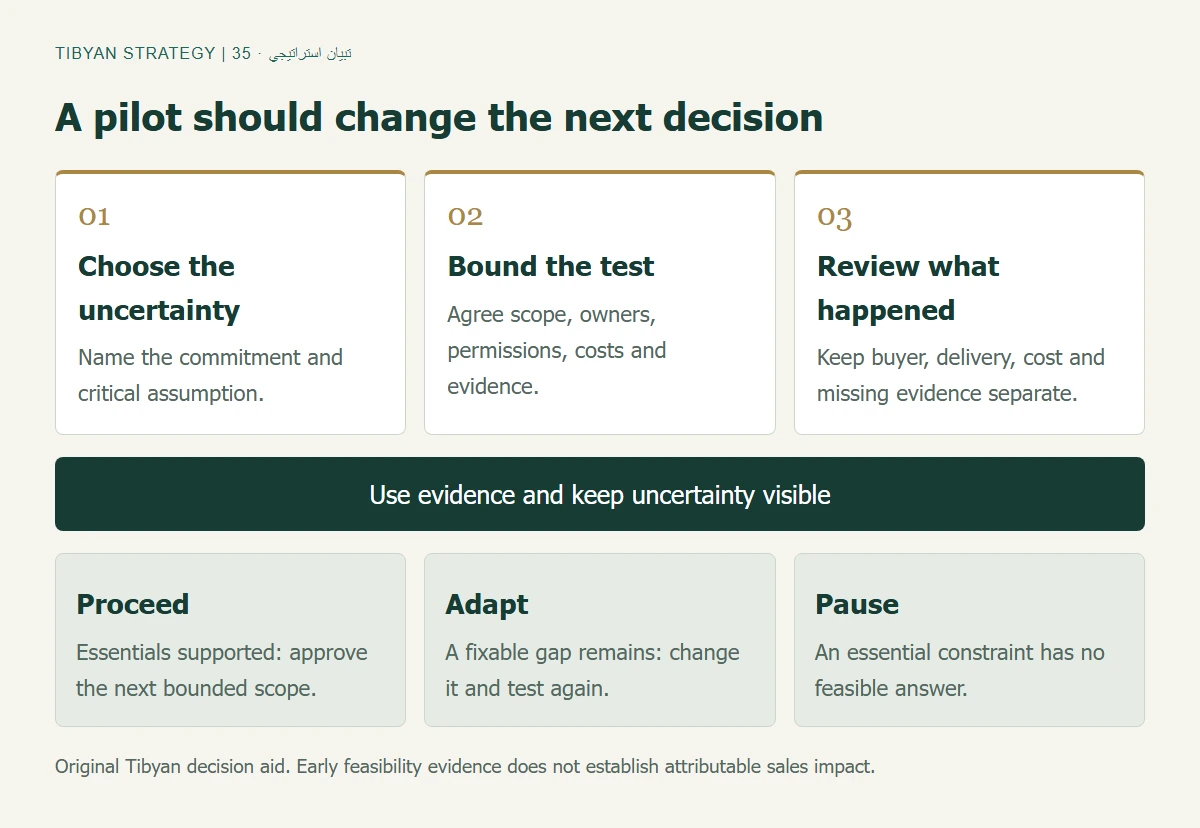 Open the diagram full size ↗
Original Tibyan pilot logic. Review buyer, delivery and economic evidence together; proceed, adapt or pause according to the defined decision. The gates are context-specific working conditions, not universal success thresholds.
An activity is something the team did. An observation is what was seen under particular conditions. A decision is what that evidence justifies next. Mixing the three can turn “sent invitations” into “validated demand.”
For buyer evidence, retain the number of eligible or targeted accounts, those contacted, responses and completed conversations. Record why information is missing. An account not contacted is not a rejection, and a response is not necessarily a qualified opportunity.
For delivery evidence, preserve the task, conditions, outcome, assistance and unresolved exceptions. Keep failed attempts. For economics, record actual spending and what it covers, while separating excluded costs and future estimates. Budget remaining is not a return on investment.
Keep an assumption and change log. If you narrow the offer, replace the partner lead or add supplier support, the later observations describe a changed intervention. Document the version and reason so the team can interpret the result honestly.
All counts, costs, organizations and observations below are invented. They are not Tibyan results, a representative sample or market benchmarks. An industrial-monitoring supplier tests one segment and a referral/service arrangement in a chosen Arab country. The example's buyer and service needs are fictional, not country requirements.
| Account evidence in the fictional preparation test | Count |
|---|---|
| Target accounts | 12 |
| Contacted | 8 |
| Not contacted | 4 |
| Responded among contacted accounts | 5 |
| Contacted without a response | 3 |
| Completed discovery | 3 |
| Responded without completed discovery | 2 |
The partitions matter: twelve equals eight contacted plus four not contacted; eight equals five responses plus three without a response; five equals three completed discovery conversations plus two without completed discovery. Three of eight contacted accounts completed discovery in this bounded test. That is a description of the test, not a market conversion estimate. Investigate why the other two responders did not complete discovery rather than deleting them from the record.
The fictional team also conducts two simulated installation attempts. One meets the agreed task criteria; the other needs escalation. These are not live customer outcomes. The second attempt reveals a coordination issue that meeting counts cannot resolve.
The approved preparation cap is 25,000 currency units (CU); actual preparation spending is 18,000 CU. The team has used 72% of that cap. The remaining 7,000 CU is unspent allowance, not profit or evidence that expansion is worthwhile. Verify what the spending includes and which future costs are still unknown.
Adapt the preparation test before committing to a live pilot. Suppose the second installation needed escalation because the local team could not identify who could approve a site-preparation exception. The operations lead assigns an approver and reruns the scenario with the people, tools and support planned for the live pilot. To pass, the team must identify the exception, obtain the required decision and complete the installation against the agreed criteria using that support.
Finance estimates the full cost of the proposed live pilot, including partner fees, travel, installation and follow-up support. At the next review, the sponsor can authorize one live installation if the retest passes, the customer agrees to the scope and responsibilities, and the estimated cost fits an approved live-pilot budget. If any condition remains open, resolve it before committing to a customer date. Do not expand simply because three meetings happened or spending stayed below the cap.
Begin the review with the original question and the actual version tested. Summarize evidence that supports the proposed arrangement, evidence against it and unresolved limitations. Include uncontacted accounts, missing records and failed attempts where they affect interpretation.
Weak conclusion: “The pilot generated meetings and used only 72% of budget. Scale up.”
Stronger, still hypothetical: “The preparation test produced three discovery conversations among eight contacted accounts. It did not establish a repeatable service arrangement: one of two simulations required escalation. Clarify that dependency and full costs before a decision on a limited live pilot. No general demand or revenue-impact claim is supported.”
HM Treasury distinguishes early feasibility learning from later causal evaluation and recommends methods proportionate to the question. A small commercial pilot can inform feasibility without showing that the pilot caused improved sales. Stronger impact claims require an appropriate evaluation design. Test and Learn.
Then record the next commitment precisely. “Adapt” should state what changes, who owns it, what evidence is required and when it will be reviewed. “Proceed” should define the authorized scope, not silently convert a bounded test into full market entry. “Pause” should protect existing obligations and identify what would permit reconsideration.
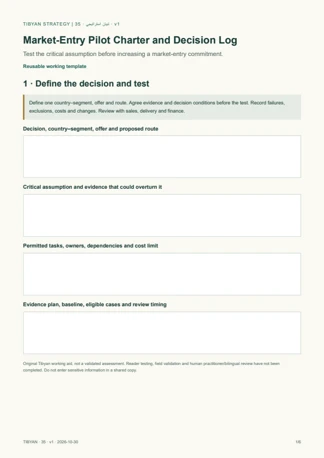
Use the free Market-Entry Pilot Charter and Decision Log (PDF) to define the decision, plan work, keep evidence and record the next commitment. It includes blank templates and an annotated hypothetical example.
You can also use the editable, printable working pack and download your edited copy.
Take your intended next investment to sales, operations and finance. Ask each owner which assumption could make it a poor decision and what observation would change their view. Design the smallest useful permitted test of that uncertainty. Review delivery readiness before making a customer-facing promise.
If the team cannot agree what a pilot should establish, you can discuss the decision with Tibyan.
This article adapts official guidance and adds an original working method. Its example is hypothetical; the charter and gates have not been field-validated. Intended-reader testing in both languages, independent practitioner/bilingual review and permissioned field cases remain needed. Record real outcomes with their context, costs, period and alternative explanations before making an empirical claim.
Cover: original AI-generated conceptual artwork. Diagram and working pack: original Tibyan editorial designs.
Related free resource: supporting working tool.
Sources checked 30 October 2026.
Take the next step
Free downloads. No registration. Each PDF includes instructions, an illustrative example and a reusable worksheet.
Tibyan Toolkit 35
Test the critical assumption before increasing a market-entry commitment.
PDF · 6 pages · 70 KB · Version 1
Download English PDF Open editable working template ↗Practical worksheets, not validated assessments. Adapt the task and timing to your context. See each PDF for its revision date.
Explore the tools & toolkits library ↗Practise discovery, qualification, value conversations and negotiation in organizational sales. Build a practical toolkit for progressing opportunities with buyer evidence.

Practical perspective
Prepare a B2B quotation that procurement, finance, and operations can assess. Use Tibyan’s QUOTE Framework, an annotated example, and a 13-point checklist.
Read perspective
Sales Training
Reconcile quoted and actual delivery margin, then trace the biggest differences to the work performed, the agreed scope and the decisions behind them.
Read perspective
Practical perspective
Run a one-week workload experiment around verifiable buyer progress and effort.
Read perspective