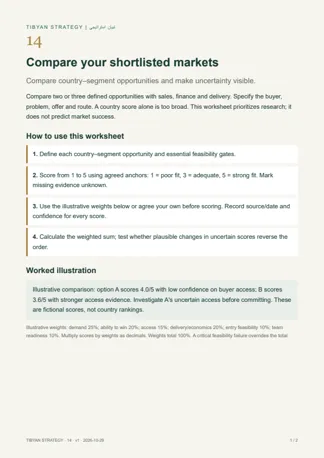
Tibyan Toolkit 14
Compare your shortlisted markets
Compare country–segment opportunities and make uncertainty visible.
PDF · 2 pages · 65 KB · Version 1
Download English PDFCompare specific country–customer opportunities using demand evidence, access, delivery economics, and entry conditions before committing expansion resources.

A large economy, a promising exhibition, or an enthusiastic potential partner can put a country at the top of an expansion list. None answers the full question: can your company win and serve a specific group of customers there on acceptable terms?
What you can put into practice: Compare defined country–customer opportunities using evidence and confidence. Select the next research task before committing expansion resources.
“Saudi Arabia versus Morocco” is too broad. “Preventive maintenance services for privately owned food-processing plants in a defined industrial area” is a researchable opportunity. Specify the customer, problem, offer, buying route, and delivery model for each option.
Start with two or three plausible options rather than scoring every country. Include your existing market as a reference where useful: expansion must compete with other uses of management time and capital.
Avoid conflating government procurement with private-sector selling. A distributor handling equipment and a consultancy delivering services also face different operating questions.
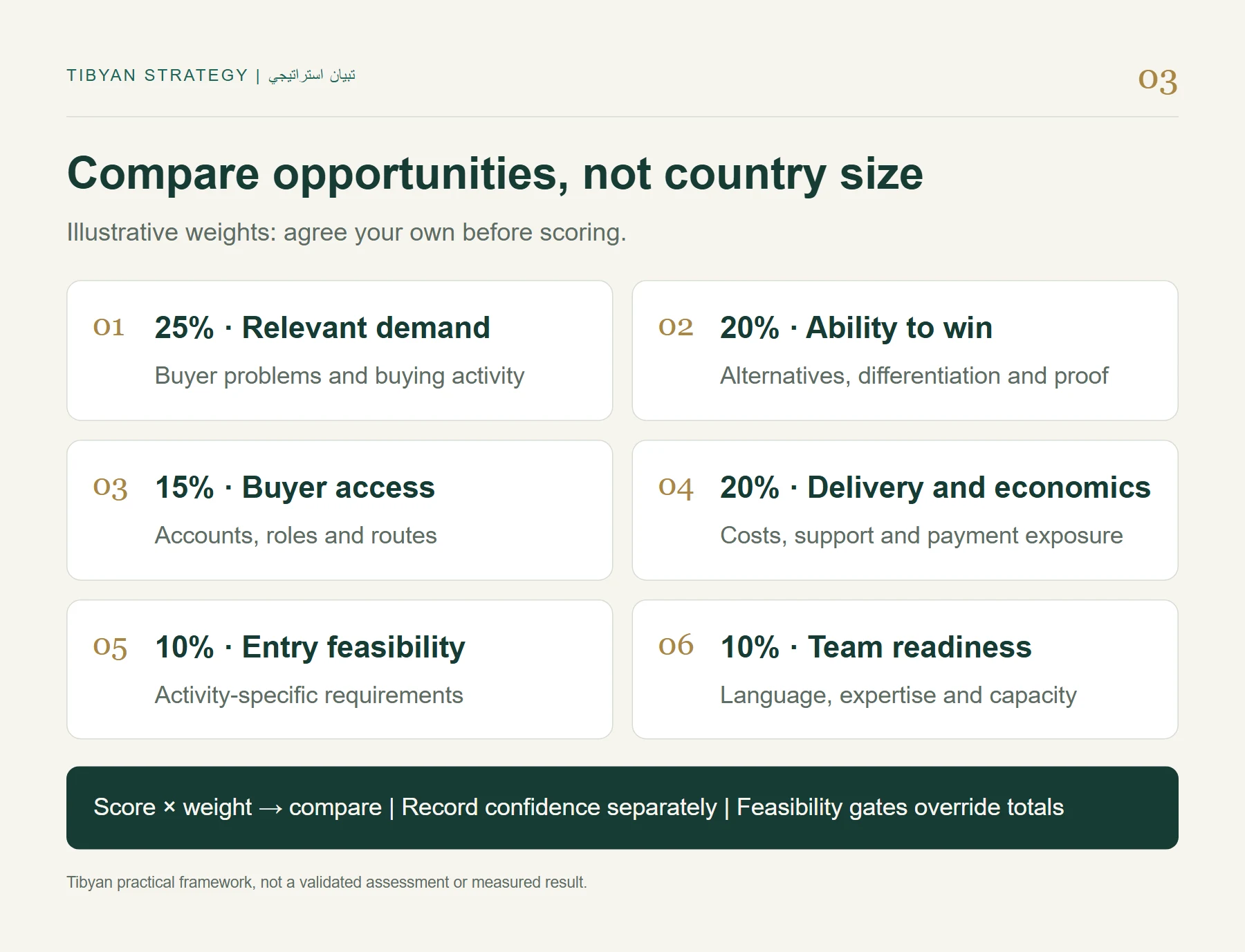
Tibyan proposes the following scorecard as a management aid. The weights are illustrative, not validated predictors of market success.
| Criterion | Illustrative weight | Evidence to seek |
|---|---|---|
| Relevant demand | 25% | Buyer problems, budgets and actual buying activity |
| Ability to win | 20% | Alternatives, differentiation and credible proof |
| Access to buyers | 15% | Reachable accounts, buying roles and channel options |
| Delivery and economics | 20% | Local service needs, full costs and payment exposure |
| Entry feasibility | 10% | Current activity-specific requirements |
| Team readiness | 10% | Language, technical coverage and management capacity |
Score each criterion from one to five against definitions agreed beforehand. Multiply the score by the weight and sum the results. The result is a score on the same one-to-five scale.
Alongside every score, label confidence high, medium, or low and record its source and date. Do not interpret missing information as an average score. Leave it unknown and commission the research.
 Open the diagram full size ↗
Tibyan practical framework. Open the diagram for a larger view; the steps and qualifications are explained in the text.
The International Trade Administration's Morocco guide, dated August 2025, advises French or Arabic versions of promotional and technical materials and emphasizes support for machinery and equipment. That prompts questions about your buyer's documentation and service requirements; it does not establish the language needs of every Moroccan account. Morocco selling guidance.
Its UAE guide, also from August 2025, identifies trade events and local distributors or agents as possible routes to buyers, with due diligence important for partner selection. A contact made at a regional event still needs account-level qualification. UAE market-entry guidance.
These guides are written for US exporters. Their commercial questions can inform research, while eligibility, tax, licensing, and procurement rules must be checked against current local authorities for your business and activity.
Hypothetical example—not a country ranking. A training provider compares the same management-development offer for a defined private-sector segment in Saudi Arabia and Morocco.
Using its own illustrative evidence, the Saudi option scores 4.0/5 but has low confidence on buyer access and delivery costs. The Morocco option scores 3.6/5 with stronger evidence on those points.
The manager should not automatically choose 4.0. The next decision might be to verify Saudi access through buyer interviews while testing the Moroccan offer with a reachable account. Neither score represents measured market attractiveness.
Check sensitivity: if plausible changes to one uncertain score reverse the order, the decision depends heavily on that assumption.
A weighted total should never override a critical barrier. Identify separately whether the company can legally deliver the activity, meet essential customer requirements, finance the sales and delivery period, and provide necessary service coverage.
Record a gate as unresolved until credible evidence is available. If it fails, redesign the route or pause that option, even when its total score is high.
Hold a 45-minute comparison meeting with sales, finance, and delivery. Assign one person to resolve the highest-impact unknown for each shortlisted option. Return with evidence, not a more polished opinion.
Download the market-selection scorecard. Compare two or three country–segment opportunities. Record evidence and confidence, check feasibility gates, and assign the next research task.
Need help preparing your team to apply this guide? Discuss the sales tasks, customer conversations, and practical learning your team needs. Discuss your team's development with Tibyan.
Explore the complete Sales Training collection.
Cover: AI-generated conceptual illustration. Explanatory diagram: Tibyan editorial design.
Sources checked: 29 October 2026. Weights, scores and meeting format are illustrative Tibyan recommendations.
Take the next step
Free downloads. No registration. Each PDF includes instructions, an illustrative example and a reusable worksheet.
Tibyan Toolkit 14
Compare country–segment opportunities and make uncertainty visible.
PDF · 2 pages · 65 KB · Version 1
Download English PDFPractical worksheets, not validated assessments. Adapt the task and timing to your context. See each PDF for its revision date.
Explore the tools & toolkits library ↗
Practical perspective
Prepare a B2B quotation that procurement, finance, and operations can assess. Use Tibyan’s QUOTE Framework, an annotated example, and a 13-point checklist.
Read perspective
Talent Development
Check whether the task still matters, how people learn it and what gets in their way before you keep, redesign or retire a course.
Read perspective
Team development
Follow one customer case across teams and find which handoff lost the facts, ownership or promise.
Read perspective