By the end of this guide, you can: Create a verification record that identifies claim status, source support, uncertainty and the resulting decision.
Bring to the task: An AI-generated response, the intended use and access to relevant original sources.
An AI response gives a neat statistic, a plausible citation and a confident recommendation. None of these establishes that the statistic exists, that the source supports it or that it applies to your decision. Verification is a separate task with its own questions and evidence.
Begin with intended use. A casual brainstorming suggestion needs a different level of checking from a claim that will enter a client proposal or a teaching article. Identify the statements that could materially change an action, harm understanding or mislead another reader. Spend verification effort where the consequence matters.
Extract claims before checking the answer
Separate factual statements, interpretations, calculations and recommendations. A factual statement may be checked against a record or original publication. An interpretation needs evidence and alternative explanations. A calculation needs checked inputs and a reproducible method. A recommendation also depends on goals, constraints and judgment.
NIST’s Generative AI Profile identifies risks including confabulation and information integrity. Use that guidance to justify deliberate checking; it does not certify this worksheet or make an AI answer safe because a source is attached. NIST AI 600-1.
 Open the diagram full size ↗
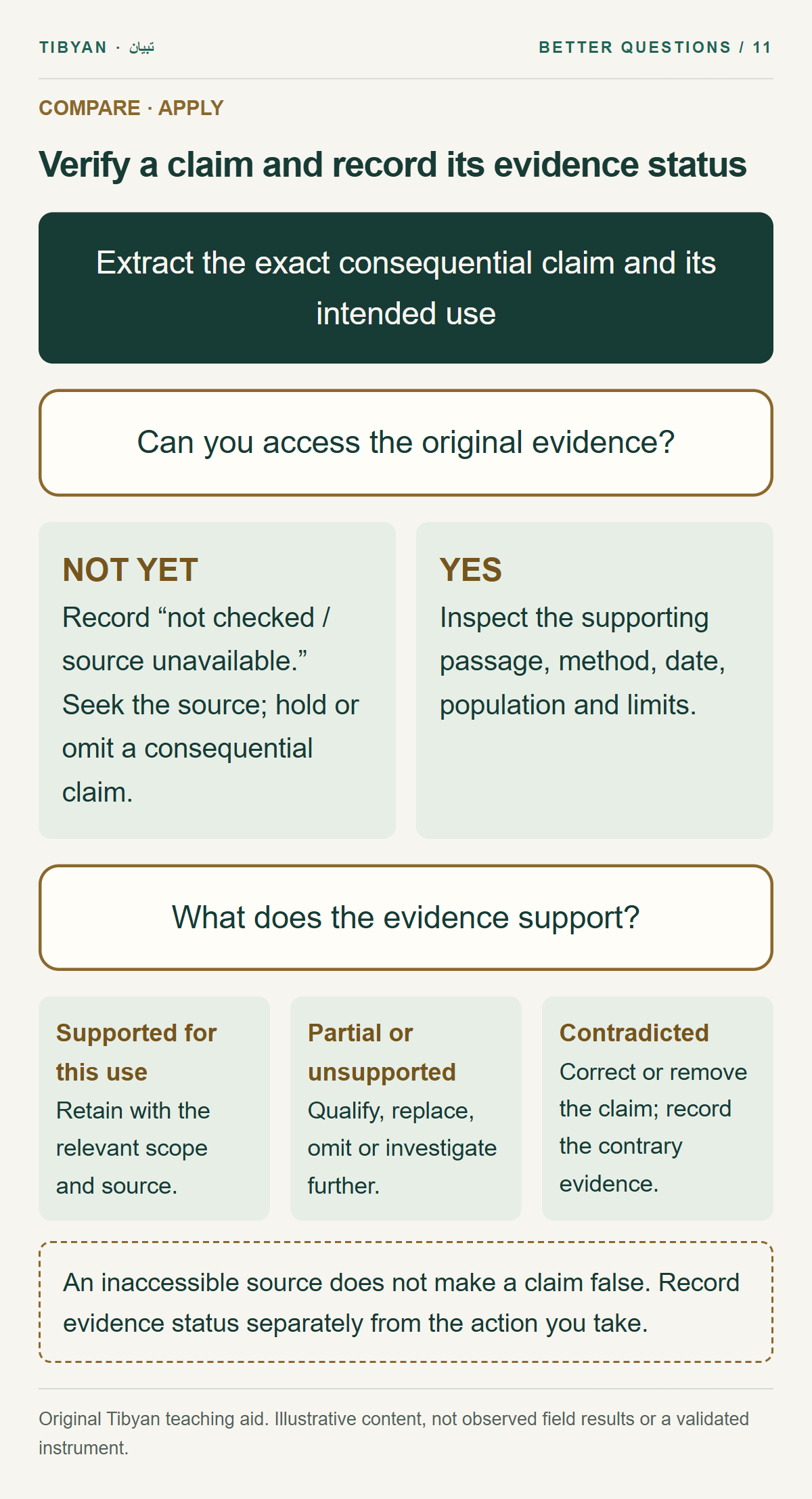
First ask whether the evidence was accessible, then what it supports. Record evidence status separately from whether you retain, qualify, hold, replace or omit the claim.
- Verify a claim and record its evidence status
- Extract the exact consequential claim and its intended use
- Can you access the original evidence?
- NOT YETRecord “not checked / source unavailable.” Seek the source; hold or omit a consequential claim.
- YESInspect the supporting passage, method, date, population and limits.
- What does the evidence support?
- Supported for this useRetain with the relevant scope and source.
- Partial or unsupportedQualify, replace, omit or investigate further.
- ContradictedCorrect or remove the claim; record the contrary evidence.
- An inaccessible source does not make a claim false. Record evidence status separately from the action you take.
- Original Tibyan teaching aid. Illustrative content, not observed field results or a validated instrument.
Open the original source and inspect the support
Check the author or institution, publication date, methods, population, setting and the passage supporting the claim. Does the source report the result directly, summarize another work or merely discuss a possibility? A university logo on a marketing page is not equivalent to an original study.
Ask whether the source supports the exact strength of the sentence. An association does not establish causation. A finding among students in one course does not automatically apply to managers. A source about a previous model or product version may not describe a current feature. If you cannot access the relevant evidence, mark that limitation rather than writing as though you read it.
A worked correction
 Open the diagram full size ↗
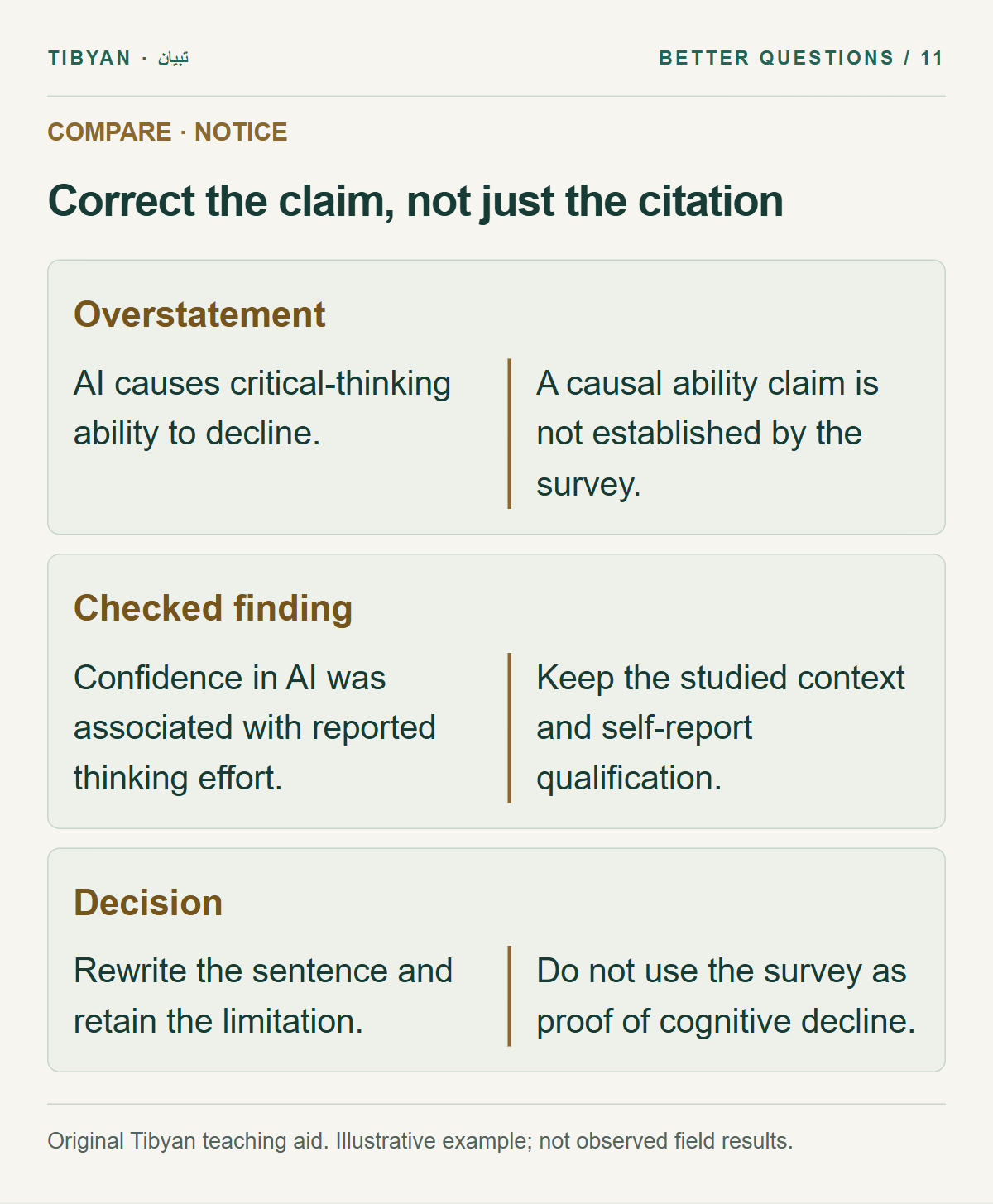
Correct the strength and object of the claim: reported effort is not measured ability, and an association is not a causal effect. Retain the source and its scope.
- Correct the claim, not just the citation
- Overstatement
- AI causes critical-thinking ability to decline.
- A causal ability claim is not established by the survey.
- Checked finding
- Confidence in AI was associated with reported thinking effort.
- Keep the studied context and self-report qualification.
- Decision
- Rewrite the sentence and retain the limitation.
- Do not use the survey as proof of cognitive decline.
- Original Tibyan teaching aid. Illustrative example; not observed field results.
Another draft might claim that higher assisted task scores prove lasting learning. A randomized mathematics study distinguishes assisted practice from later unaided performance. Its context also matters: it does not prove that all current AI use helps or harms all learning. Bastani and colleagues.
Seek a challenge outside the original response
Ask what independent evidence would weaken the claim. Repeated websites may all copy one report. Two AI systems may reproduce the same unsupported statement. Treat agreement as a reason to investigate, not independent corroboration by itself. Trace important claims to their origin and look for relevant corrections or later evidence.
For a numerical claim, check the denominator, unit, comparison, period and whether a percentage is relative or absolute. Recalculate when the inputs are available. For a quotation, inspect the wording and context. Remove the quotation if you cannot verify it; a careful paraphrase still needs a source.
Record a usable status
Use statuses such as supported for this use, partly supported, unsupported, contradicted or not yet checked. Add the source, relevant finding, applicability limit and your action: retain, qualify, replace, omit or investigate further. A blank cell is not a pass.
The final judgment remains human. A second AI can suggest checks, but asking it whether it is certain does not resolve the evidence. Where consequences require specialist expertise, obtain it before relying on the output.
For practice, inspect three consequential claims in a response. Verify one against an original source, identify one overstatement and record one unresolved point. Rewrite the answer so its certainty matches the evidence.
Complete a three-claim verification ledger
The following AI draft and business numbers are fictional teaching material, revised 11 November 2026. The Lee publication linked below is a real source; the invented draft is intentionally inaccurate.
1. “Research proves that AI reduces workers' critical-thinking ability.”
2. “Our clarification rate fell by two percentage points after the checklist.”
3. “An unspecified report proves this checklist doubles every team's productivity.”
Supplied fictional record for claim 2: before, 8 requests needed clarification out of 40 reviewed; after, 6 out of 50. The periods contain different tasks and there is no comparison group. No source, author or URL is supplied for claim 3.
Corrected sentence for claim 1: “In the surveyed tasks, greater confidence in generative AI was associated with lower self-reported critical-thinking effort; this does not establish a causal decline in ability.”
Corrected sentence for claim 2: “In this fictional record, clarification rates were 20% and 12%, a difference of eight percentage points. Different task mixes and the absence of a comparison prevent attributing the change to the checklist.”
Claim 3's disposition: omitted from the teaching recommendation; verification remains open. Do not replace “unverified” with “false.”
Audit entry: exercise check recorded on 11 November 2026 by the fictional teaching reviewer. In real use, record the actual checker, date, accessible source, page or section and revised wording. If a PDF or report cannot be opened, say so; do not imply you read it. A second AI's agreement does not supply an independent source.
Weak completion: “The citation is from a respected institution; retain all three.” Improved completion: attach the exact source support to each claim, recalculate the numerical comparison, and leave the unavailable-source claim unresolved. A credible source name is the beginning of appraisal, not its conclusion.
Your reusable working record
Open the editable working tool · Download the printable pack
- Intended use and consequence: Prioritize the claims that affect the decision or reader understanding.
- Claim 1: exact original sentence: Preserve the wording being checked.
- Claim 1: source/title/date/locator: Use the original page or document, not only an institution name.
- Claim 1: support, method and applicability: Keep effort distinct from ability and association from causation.
- Claim 1: status and revised wording: Write the usable correction, not “qualify it.”
- Claim 2: exact claim, inputs and source: Keep numerator, denominator and period visible.
- Claim 2: reproducible calculation and uncertainty: Distinguish percentage points from relative percentage change.
- Claim 2: status and actual replacement: Correct the error and avoid adding a causal conclusion.
- Claim 3: exact claim and accessible source: A missing citation remains a verification gap.
- Claim 3: evidence status and disposition: Do not confuse not checked with contradicted.
- Checker, check date, unresolved items and release decision: For real use, enter the actual person and observation date.
Practice and retry
Complete all three claim records without viewing the answer column. Open the real Lee source for claim 1; recalculate claim 2 from the supplied fictional counts; mark claim 3 honestly when its source is unavailable. Rewrite the draft and have a partner repeat one check from your locator.
Common error and corrective feedback
Common errors: accepting an institutional logo instead of checking support; using one denominator for two periods; confusing relative percent change with percentage points; calling an inaccessible source disproved; asking another AI for certainty instead of obtaining evidence.
Independent-study alternative
Use the three supplied claims. Check the real source if online access is available; if not, mark claim 1 not checked and complete the arithmetic and source-unavailable records. Reopen the real source later before treating the corrected research sentence as verified.
Check your work
- The exact claim is identified.
- The source was opened and supports the wording.
- Method and applicability limits are recorded.
- The status leads to an explicit action.
Apply and review
Before sharing the output, check whether the consequential claims are resolved or visibly qualified and retain the verification record.
Continue the learning route
Previous: Use AI to Develop a Better Inquiry · Series overview · Next: Build a Lasting Questioning Practice
Sources and further reading