By the end of this guide, you can: Complete a small investigation and defend how your questions, evidence and judgment led to a proportionate action.
Bring to the task: A manageable work or business-study challenge, a review partner and permission to access the required non-sensitive information.
Knowing a list of question types is a starting point. Capability appears when you notice a consequential uncertainty, choose a question that addresses it, listen to the answer and revise an action. The final module turns that work into a visible investigation that another person can review.
Choose a challenge small enough to investigate responsibly. A business student might examine confusion in a group project handoff. A manager might inspect an approval delay. An entrepreneur might explore a customer’s current workaround. Do not choose a topic that requires inaccessible records or specialist decisions beyond the project’s scope.
Build an inquiry portfolio
Keep a short record of the decision, initial assumptions, questions, evidence, changes in interpretation, action and review. Include a question you discarded and why. This makes the learning process visible and prevents a polished final narrative from hiding the choices that actually mattered.
 Open the diagram full size ↗
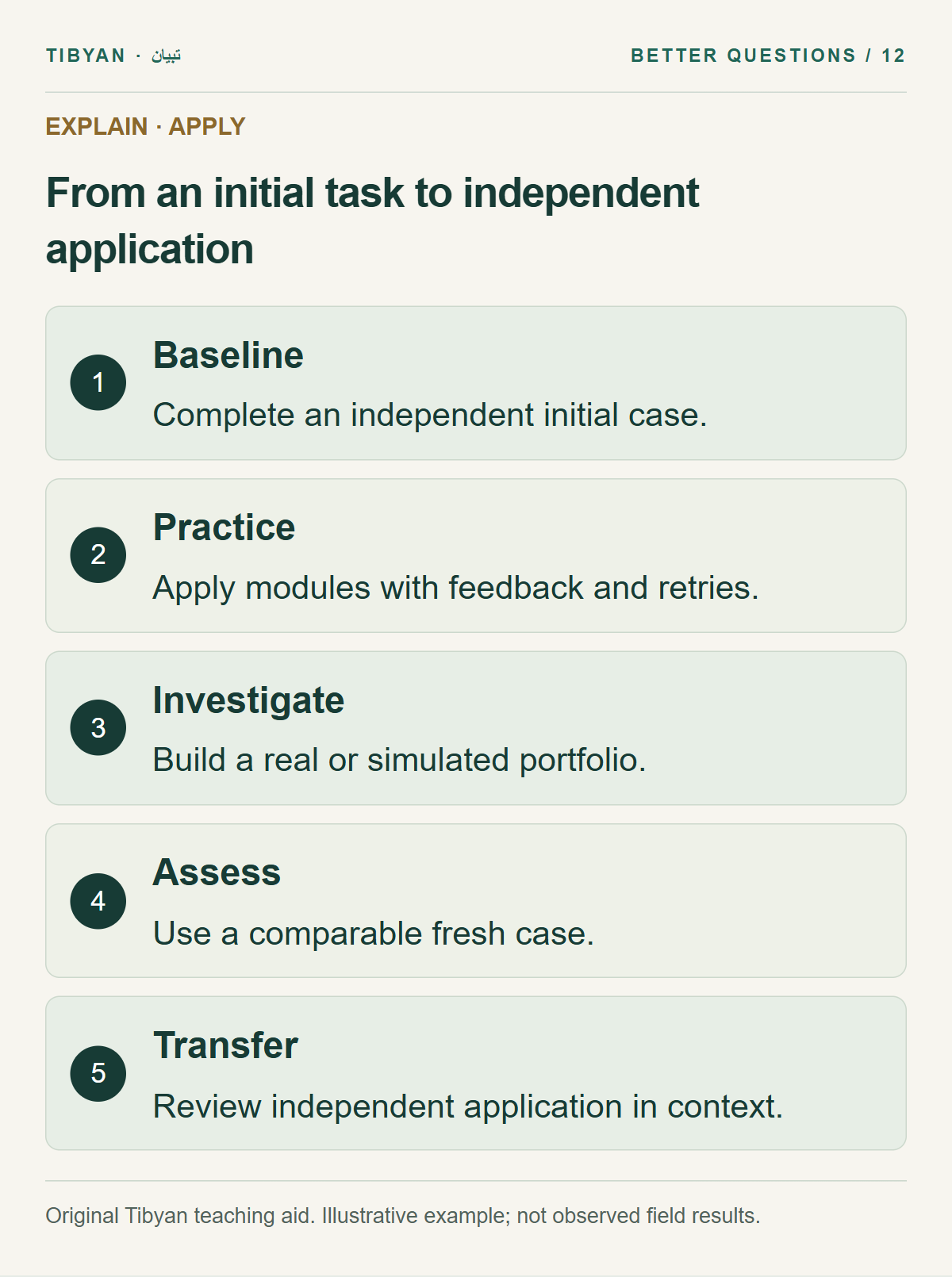
Compare independent tasks under comparable conditions, then inspect a later workplace opportunity. A final classroom artifact does not by itself demonstrate transfer.
- From an initial task to independent application
- 1. Baseline
- Complete an independent initial case.
- 2. Practice
- Apply modules with feedback and retries.
- 3. Investigate
- Build a real or simulated portfolio.
- 4. Assess
- Use a comparable fresh case.
- 5. Transfer
- Review independent application in context.
- Original Tibyan teaching aid. Illustrative example; not observed field results.
Plan repeated attempts and feedback rather than one reading session. Learning research supports practice and revisiting material, but the appropriate timing depends on the task and learners. The sequence below is an instructional design, not a tested guarantee of improved workplace performance. Donoghue and Hattie.
Use an initial task and a comparable final task
Before the learning pathway, give participants a fictional case about late internal proposals. Ask them to frame the decision, write a question sequence, compare explanations and choose the next evidence. At the end, use a different but comparable case about delayed project handoffs. Keep time, instructions, available information and scoring criteria consistent.
Include a brief live conversation or oral explanation so learners show how they respond to new information. If AI was permitted during practice, assess the selected independent task without it. Do not compare an assisted final product with an unaided baseline and call the difference learning.
 Open the diagram full size ↗
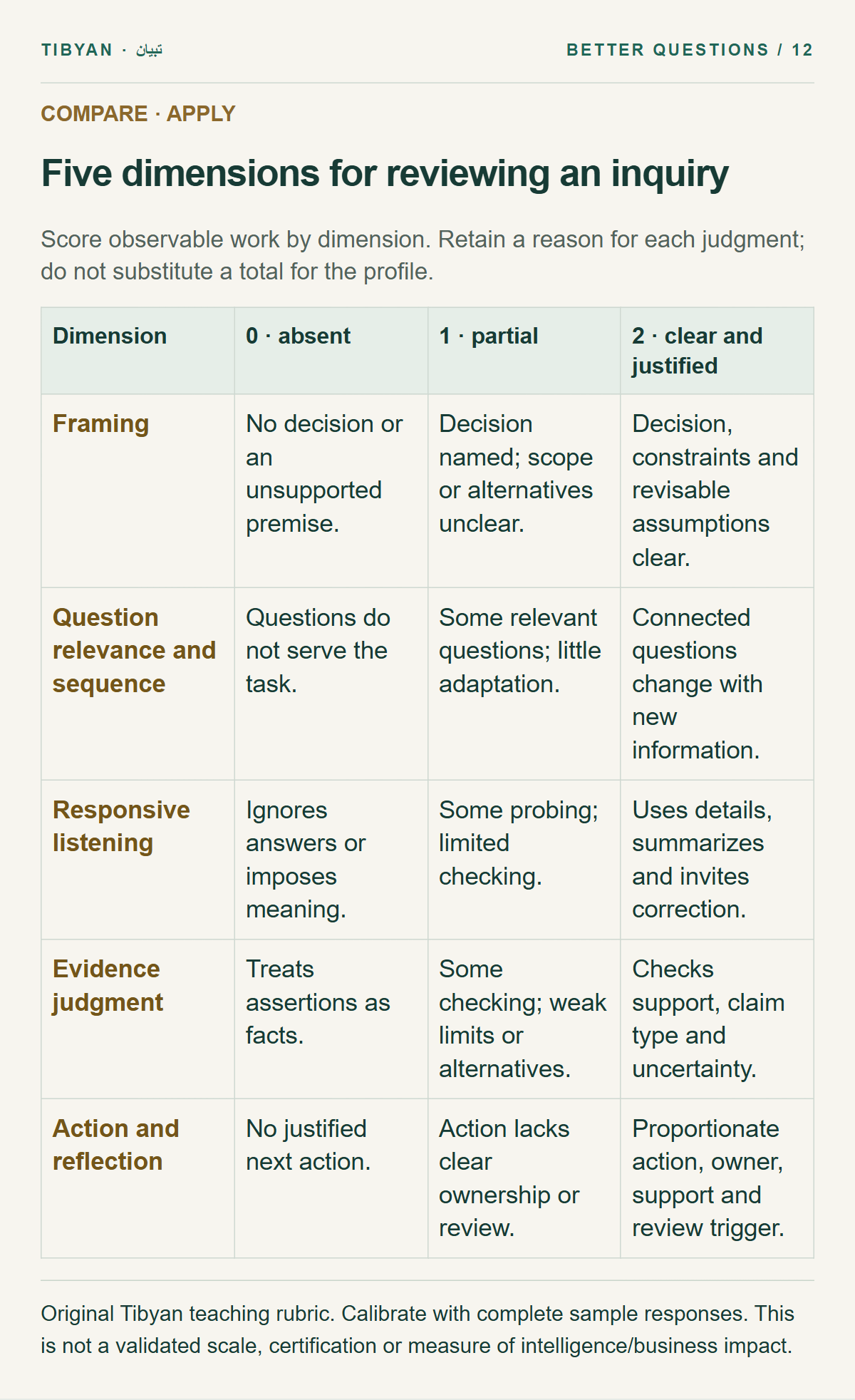
Score the five dimensions separately using observable work and a written reason. Calibrate reviewers with complete responses; the profile is not a validated certification scale.
- Five dimensions for reviewing an inquiry
- Score observable work by dimension. Retain a reason for each judgment; do not substitute a total for the profile.
- Dimension | 0 · absent | 1 · partial | 2 · clear and justified
- Framing | No decision or an unsupported premise. | Decision named; scope or alternatives unclear. | Decision, constraints and revisable assumptions clear.
- Question relevance and sequence | Questions do not serve the task. | Some relevant questions; little adaptation. | Connected questions change with new information.
- Responsive listening | Ignores answers or imposes meaning. | Some probing; limited checking. | Uses details, summarizes and invites correction.
- Evidence judgment | Treats assertions as facts. | Some checking; weak limits or alternatives. | Checks support, claim type and uncertainty.
- Action and reflection | No justified next action. | Action lacks clear ownership or review. | Proportionate action, owner, support and review trigger.
- Original Tibyan teaching rubric. Calibrate with complete sample responses. This is not a validated scale, certification or measure of intelligence/business impact.
Review observable work
Use five dimensions: framing, relevance and sequence, responsive listening, evidence judgment, and action with reflection. Score each with behavioral anchors rather than a general impression. A score of 0 indicates absent or unsupported work; 1 indicates partial work; 2 indicates a clear, justified demonstration. The original Tibyan rubric is a practical assessment aid, not a validated psychometric scale or a pass/fail certification.
Calibrate reviewers with the same sample before scoring learners. Discuss disagreements and retain a concrete reason for each judgment. Report the profile by dimension rather than using a single total to label someone a good or bad thinker. Confidence, eloquence and number of questions are not substitutes for evidence.
Complete the capstone
Your portfolio should end with a decision you can defend and a review trigger. WHO’s after-action-review guidance offers a structured way to examine experience and follow-up; its business use here is an adaptation. WHO. Ask what you expected, what happened, what conditions mattered and what you will change.
Examine transfer and impact separately
After an appropriate opportunity to apply the skill, inspect a real work record or observe a conversation with permission. Ask what the learner could do independently and what support remained necessary. Attendance, satisfaction and downloads describe participation or engagement. They do not establish learning or workplace application.
A useful pilot can test whether the materials and assessment are workable. Causal claims about business impact require a suitable evaluation design and attention to alternative explanations. Use proportionate test-and-learn reasoning to decide what to continue, adapt or stop. HM Treasury.
Close the series by choosing one habit for the next relevant task: record the decision, ask an answer-dependent follow-up or seek evidence that could change your mind. Review the habit with a partner and retain the next useful question.
A completed inquiry portfolio
All people, work records and outcomes in this portfolio are fictional. It demonstrates documentation; it is not evidence that the series has improved a real organization.
Starting decision: Salma must decide whether Namaa's next response to late proposals should address planning, technical checking or handoff communication. Rana's first question is “Which time-management course should we buy?” She discards it because it assumes the cause and selects the remedy.
Initial evidence: the module 7 packet contains one estimate arriving after its deadline, one timely case and one late, more complex case with a missing approval log. Rana asks: “Who received responsibility for the unresolved item, and how did they acknowledge it?”
New simulation evidence: message F1 names an owner for the complex case, but the coordinator's copy was not delivered. Responsibility existed on paper; communication was unconfirmed. In a second fictional demonstration, F2, Rana misses a support-coverage ambiguity in an additional-service example despite checking all four obvious omissions in the simpler exercise. These observations keep both a communication condition and a specific practice need in the diagnosis.
Revised action: Salma owns a trial of acknowledged handoffs on three suitable proposals; Rana rehearses the support-coverage check with feedback and marks unresolved commitments before issue. Salma reviews at the third case, or immediately if an unresolved commitment is about to be issued.
Invented follow-up record F3: all three trial proposals visibly mark unresolved assumptions; two meet their deadlines, while one is delayed after a customer changes scope. This is a fictional description, not a causal estimate. The combined repair and practice cannot reveal which element produced any change.
Portfolio conclusion: retain the visible status/acknowledgment procedure provisionally, investigate the changed-scope case separately, and observe Rana's next independent coverage check. A successful rehearsal and a combined trial do not by themselves establish lasting capability or revenue impact.
Use the same five dimensions throughout
The accompanying assessment packet supplies the initial/final case records, respondent cards and complete scored calibration responses. Do the initial task before studying the pathway. Keep the assistance conditions consistent; do not reinterpret a supported rehearsal as an independent assessment.
Make practice fit the next real opportunity
An optional routine is to spend a few minutes before a relevant task naming the decision and assumption; during the conversation, record one answer-dependent follow-up; afterward, review one artifact with a partner and choose the next correction. If useful in your work, collect these at a short weekly review. This is a suggested routine, not a proven frequency.
Record the task, whether help was used, what the learner actually did, what support remained and the next decision. If no suitable application opportunity occurred, record “no opportunity observed,” not failed transfer. Satisfaction and downloads concern engagement; a scored case concerns demonstrated learning; an independently observed work task concerns application. Commercial impact requires a separate evaluation.
Your reusable working record
Open the editable working tool · Download the printable pack
- Decision, owner and initial assumptions: Keep the first view visible rather than rewriting history.
- Actual questions and discarded question: Show the sequence and why a question was dropped.
- Evidence records and locators: Distinguish a simulation exhibit from actual workplace evidence.
- New information and revised interpretation: Identify what changed the view and what remains uncertain.
- Action, owner and support: Name who acts and who removes conditions outside learner control.
- Review date/condition and actual follow-up: Record the observation, not merely an intention to review.
- Assistance and independent demonstration: Do not equate supported performance with independent capability.
- Five-dimension profile and feedback: Attach scores to an actual response and record a reason per dimension.
- Learning, application and impact limits: State the level of evidence and avoid causal claims.
- Next practice opportunity and review partner: Choose a task-linked habit and say what happens if no opportunity occurs.
Practice and retry
Complete a portfolio from the supplied simulation or a permitted real task. Label the evidence type. Add the question that changed your interpretation, a discarded question, the exact next action and an observation/review condition. Complete the final assessment separately under the same assistance conditions as the initial task.
Common error and corrective feedback
Common errors: a polished hindsight story with no initial view; treating a plan as an observed action; scoring supported practice as independent skill; using a pre/post difference to claim that the course caused business impact.
Independent-study alternative
Use the fictional exhibits and assessor cards in self-study order: attempt, record your answer, reveal new information, revise, then compare with calibration. Self-scoring is formative reflection; it is not an independent rater judgment or proof of transfer.
Check your work
- The portfolio shows a specific decision.
- Questions respond to evidence and answers.
- Claims and uncertainties are distinguished.
- The action has an owner and review trigger.
Apply and review
At the next suitable application opportunity, review one work artifact or conversation and agree on the next practice goal.
Five dimensions for reviewing observable work
Score the work by dimension, retain a reason and discuss disagreements. This is a practical instructional rubric, not a validated measure of intelligence or a certification. See the learner workbook for the initial/final evidence packets and the facilitator guide for role cards and complete calibration samples.
Learner workbook · Facilitator guide
Continue the learning route
Previous: Question AI’s Answers and Verify the Evidence · Series overview
Sources and further reading