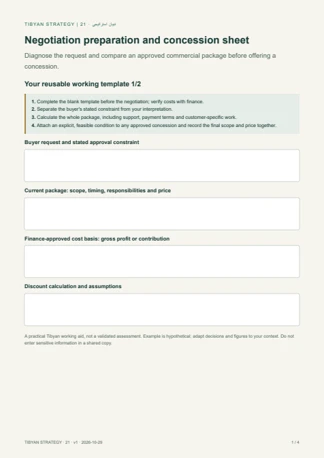
Tibyan Toolkit 21
Negotiation preparation and concession sheet
Diagnose the request and compare an approved commercial package before offering a concession.
PDF · 4 pages · 66 KB · Version 1
Download English PDF Open editable working template ↗Understand what sits behind a discount request, calculate its commercial effect and prepare conditional trades that keep scope, service and commitments clear.

A buyer asks for a 10% discount. The salesperson sees a small movement in price; finance sees a much larger reduction in the money left to serve the customer and sustain the business. Delivery may discover that the lower price still includes every urgent deadline, customization and support promise.
The right response is not an automatic refusal. It is a disciplined conversation about the buyer’s constraint, the economics of the proposed package and the commitments each side can realistically make.
Learning outcome: assess a discount request, calculate its effect using consistent cost definitions and prepare a conditional commercial proposal within your authority.
“Your price is too high” can describe several different problems. The customer may face a fixed spending limit, doubt the value, compare a narrower competitor offer or object to payment timing. Sometimes procurement is simply testing whether the first price is negotiable.
Ask what specifically prevents approval. Does the total exceed an approved budget? Which outcome or requirement is not worth the proposed cost? What is included in the alternative being compared? What can change in scope or timing?
Do not treat these questions as a technique for wearing the buyer down. A genuine budget limit may require a smaller solution. An unresolved value question requires evidence and clarification. A financing constraint should be assessed by the responsible finance team, rather than disguised as a price problem.
Before negotiating, agree which costs the decision uses. Gross profit is revenue less cost of sales under the organization’s accounting policy. Contribution is revenue less variable costs. They can differ: commissions, delivery travel or transaction costs may be variable without being classified as cost of sales.
ACCA’s pricing guidance explains how a price above marginal cost produces contribution toward fixed costs and profit, and why volume and fixed costs still matter. It does not establish the right price for a specific customer. ACCA: practical aspects of pricing.
Tibyan recommends asking finance to define the cost basis, required approvals and minimum acceptable economics. Include delivery effort, payment conditions and customer-specific obligations in the decision where relevant. A quoted percentage without its denominator and cost basis is an incomplete instruction.
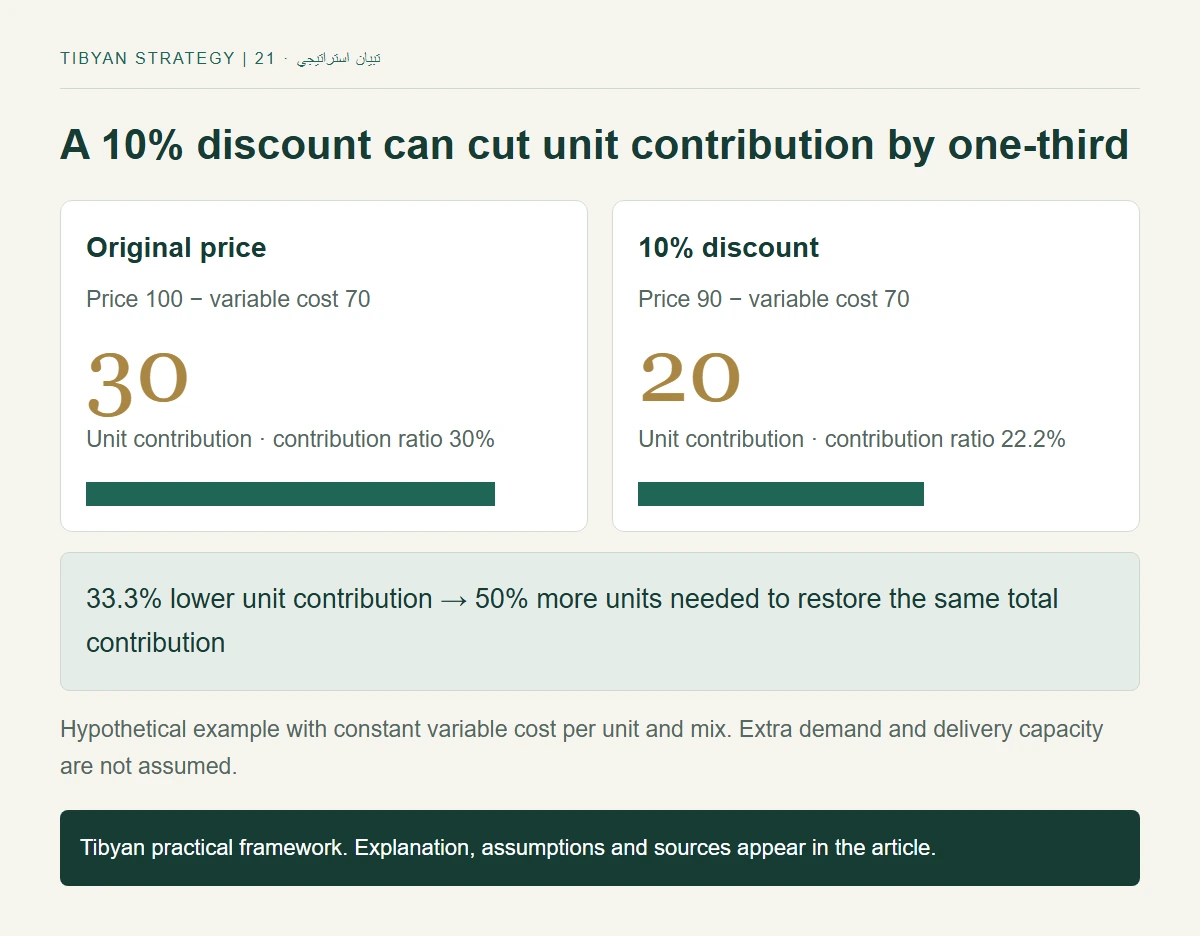
The following is an illustrative arithmetic example, not a customer case or a pricing recommendation. Assume one standard unit sells for 100 currency units and incurs 70 in variable cost. For this simplified example only, assume that the same 70 also equals cost of sales; gross profit and contribution therefore coincide.
| Measure | Original price | After a 10% price discount |
|---|---|---|
| Selling price per unit | 100 | 90 |
| Variable cost per unit | 70 | 70 |
| Contribution per unit | 30 | 20 |
| Contribution as a share of revenue | 30% | 22.2% |
| Units required to equal 3,000 total contribution | 100 | 150 |
The price falls by 10, but contribution falls by 10 out of the original 30: a 33.3% reduction. Restoring the original total contribution requires 3,000 ÷ 20 = 150 units, compared with 100 previously—a 50% increase in units.
The general calculation is original unit contribution divided by discounted unit contribution, minus one. If the discounted contribution is zero or negative, no positive increase in units restores the original positive contribution under the same assumptions.
This calculation holds variable unit cost constant. It excludes additional fixed capacity, financing, taxes and changes in product mix or service demands. It does not demonstrate that the market will buy the extra units. A larger order can also change costs and risk, so recompute the full package.
 Open the diagram full size ↗
Illustrative diagram: the example above uses invented round numbers to explain the arithmetic; it is not a market benchmark.
A negotiation can include more than the unit price. Scope, sequencing, service hours, customer preparation, contractual volume and implementation timing may change the economics. Some options will be unsuitable for your organization or customer; evaluate them rather than assuming all trades are beneficial.
| Buyer concern | Option to explore | What must be checked |
|---|---|---|
| Initial budget is limited | A narrower first phase | Useful outcome and honest exclusions |
| The customer wants faster delivery | Different scope or a supported delivery slot | Capacity and dependencies |
| The customer expects a volume price | A documented volume commitment | Demand credibility and unit economics |
| Ongoing support seems expensive | A clearly defined support package | Response needs and service boundaries |
| The comparison is cheaper | A like-for-like scope comparison | Included services, risks and evidence |
Avoid “free” additions that consume scarce delivery capacity. If an addition has a real cost or creates a continuing obligation, include it in the approval discussion.
Harvard’s Program on Negotiation advises negotiators to make concessions visible and clarify reciprocity; it also describes conditional concessions. This is professional negotiation guidance, not proof that a concession will secure a deal. Program on Negotiation: making concessions.
Tibyan’s suggested phrasing is specific: “If the first phase covers one production line and your team completes the agreed data preparation, we can revise the package to this price, subject to delivery approval.” The condition explains what changes; it should not conceal exclusions.
Record the complete package. A discount agreed in one email and a scope expansion accepted in another can create an unintended commitment. Summarize price, scope, customer responsibilities, delivery timing and the outstanding approvals together.
A maintenance-analytics supplier proposes a pilot covering two production lines. The customer requests a 10% reduction because the approved pilot budget is smaller than expected. The salesperson initially considers preserving the full scope and absorbing the difference.
The team asks which outcome matters first. The customer needs to test whether maintenance planners will use the exception reports; comparing both lines is useful but not essential to the first decision. Delivery estimates a smaller pilot on one line, checks the data assumptions and identifies the support included.
Suppose the original two-line pilot is priced at 100,000 currency units and costs 70,000 to deliver on the agreed contribution basis. It leaves 30,000 in contribution. Giving the requested 10% discount for the same work would leave 20,000. The one-line option is priced at 75,000 and costs 52,000 on the same basis, leaving 23,000. In this illustration, Finance requires at least 22,000 in contribution. The one-line pilot clears that floor.
The customer’s project owner confirms that one line is enough for planners to test the exception reports. The offer includes a preparation checklist and a capped set of workshops. Any expansion requires a separate decision. Finance checks the cost and contribution estimates, and Delivery confirms the scope and support before Sales offers the revised price.
This does not prove that discounting was avoided or that the customer will accept. It demonstrates how the team can respond to a real constraint without quietly promising the original package for less.
The salesperson should know which variables can change, what requires approval and what information the approver needs. “Ask my manager” becomes more useful when paired with a complete commercial comparison.
Tibyan suggests a one-page preparation sheet containing the buyer’s stated concern, proposed price and cost basis, acceptable alternatives, conditions attached to concessions, authority limits and a clear next step. Keep internal limits confidential and respect the organization’s access controls.
After the conversation, compare the final agreement with the approved version. Record exceptions and unresolved items before signature. Do not describe tentative terms as approved, and never invent scarcity, competing offers or a decision deadline to create pressure.
Take a recent discount request. Write the buyer’s constraint in their words, identify what remains unverified and calculate the contribution effect with finance-approved inputs. Prepare two feasible packages and state the conditions for each.
Download the free negotiation preparation and concession worksheet.
If poor-fit customers repeatedly require exceptions, revisit customer fit and profitability. A recurring discount problem may begin earlier than the negotiation.
You can also use the editable, printable working template. Download an edited copy from your browser without submitting your entries.
Explore the Sales Training collection.
Cover: AI-generated conceptual artwork. Diagram and tool: original Tibyan editorial design.
Take the next step
Free downloads. No registration. Each PDF includes instructions, an illustrative example and a reusable worksheet.
Tibyan Toolkit 21
Diagnose the request and compare an approved commercial package before offering a concession.
PDF · 4 pages · 66 KB · Version 1
Download English PDF Open editable working template ↗Practical worksheets, not validated assessments. Adapt the task and timing to your context. See each PDF for its revision date.
Explore the tools & toolkits library ↗
Practical perspective
Prepare a B2B quotation that procurement, finance, and operations can assess. Use Tibyan’s QUOTE Framework, an annotated example, and a 13-point checklist.
Read perspective
Talent Development
Check whether the task still matters, how people learn it and what gets in their way before you keep, redesign or retire a course.
Read perspective
Team development
Follow one customer case across teams and find which handoff lost the facts, ownership or promise.
Read perspective