Tibyan Toolkit 07
Five questions after an activity
Help participants move from an experience to a practical next step.
PDF · 8 pages · 114 KB · Version 1
Download English PDFTurn one activity or work example into a clear next step with a five-question debrief, a 15-minute meeting and a value proposition role-play.
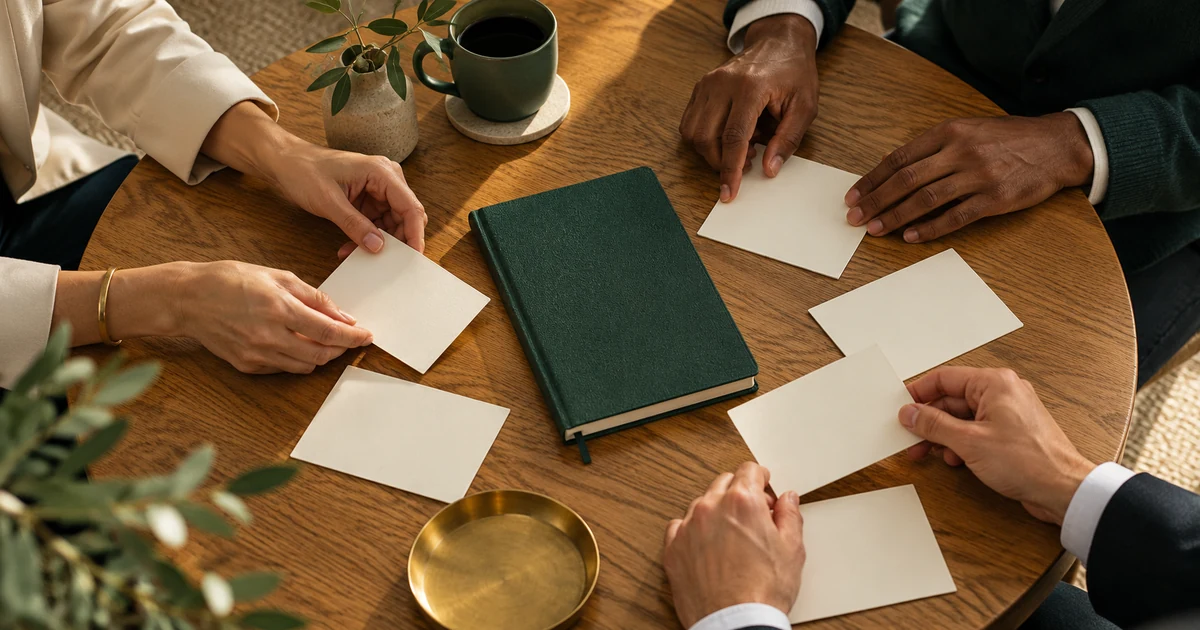
An activity can create energy without changing what the team will do next. People enjoy the role-play, say that communication matters, and return to the same habits. A focused debrief helps a group describe what happened and agree what to try.
This guide offers a facilitation routine for a trainer or manager. The five questions and meeting agenda are practical prompts, not a validated diagnostic instrument. Use tools 07–09 below with a real work question or a clearly labeled simulation.
Before starting, write the question the group should be able to explore. For a customer conversation: “Can we explain the customer's need and our approach without adding an unsupported promise?” Provide the situation, roles and review criteria in advance.
Make participation workable. Offer a written response before speaking, allow preparation time and provide an observer role when appropriate. In a mixed Arabic–English group, agree the working language and explain unfamiliar terms. Do not assume that silence indicates agreement or that language fluency equals subject expertise.
Ask for a brief written observation first, then invite contributions. Keep “what happened” distinct from “why we think it happened.” If two participants interpret an event differently, return to the example rather than deciding which person is right by seniority.
Tool 08 gives a compact format: select one example, examine what it shows, discuss an adjustment and record the next test. Fifteen minutes is a suggested meeting design. Extend or split the conversation if the issue needs more evidence or specialist input.
| Time | Conversation |
|---|---|
| 0–2 minutes | Confirm the task and purpose |
| 2–6 minutes | Review one suitable sample |
| 6–10 minutes | Compare observations and identify a useful change |
| 10–13 minutes | Agree an owner and a realistic next attempt |
| 13–15 minutes | Record the review point and unresolved questions |
Keep the sample small: a paragraph, a meeting record or a fictional customer request. A routine learning discussion should not be used to resolve an urgent operational incident or a confidential personnel matter. Arrange the appropriate separate conversation when needed.
Use tool 09 with pairs or groups of three: speaker, customer and observer. The speaker explains who the offer serves, the need it addresses and the approach. The customer asks for clarification and evidence. The observer notes an exact phrase that was clear and one question left unanswered.
Swap roles, revise the statement, and try again. For a longer session, use the existing value proposition team exercise. The output is a clearer draft and a question to investigate. A successful simulation does not validate market demand or establish that customers will buy.
Illustrative, fictional example. A studio's team describes its offer as “everything your business needs.” In the role-play, the customer asks whether that includes website maintenance. The speaker realizes the phrase is broader than the actual offer.
The debrief identifies the exact wording, the misunderstanding it could create and a narrower alternative. The team drafts: “We help small retailers prepare a consistent visual identity for their launch materials.” Before using it externally, the owner checks that it accurately describes the service. The next action is to review another sample conversation; no conversion increase is claimed.
Prepare a debrief question for each exercise before preparing the slides. Listen for evidence that participants can use the idea, and avoid turning every response into a lecture. Keep examples appropriate for the audience's experience and authority. When the group needs more technical content, acknowledge the gap and arrange a qualified source.
Managers and business owners: bring a work example the team is authorized to discuss and model a willingness to revise your own wording. Students: use a project pitch and take turns observing. The observer should cite the output rather than score a person's character. Store only the notes needed for the agreed action.
Avoid asking only “Did you enjoy it?”, allowing the most senior participant to answer first every time, or ending with “we should communicate better.” Use the downloads below to record one change and one follow-up. Connect the next attempt to evidence of learning and application, or explore team development support.
Take the next step
Free downloads. No registration. Each PDF includes instructions, an illustrative example and a reusable worksheet.
Tibyan Toolkit 07
Help participants move from an experience to a practical next step.
PDF · 8 pages · 114 KB · Version 1
Download English PDF
Tibyan Toolkit 08
Review one real example and agree on one small improvement.
PDF · 8 pages · 114 KB · Version 1
Download English PDF
Tibyan Toolkit 09
Use a paired role-play to make your message clearer.
PDF · 8 pages · 114 KB · Version 1
Download English PDFPractical worksheets, not validated assessments. Adapt the task and timing to your context. See each PDF for its revision date.
Explore the tools & toolkits library ↗Practise clearer feedback, useful check-ins and reliable handovers. Leave with a conversation checklist and a team agreement you can apply at work.

Talent Development
Check whether the task still matters, how people learn it and what gets in their way before you keep, redesign or retire a course.
Read perspective
Practical perspective
Compare two deals using the same observable criteria and record what changed about the conditions.
Read perspective
Practical perspective
Pick one recurring sales behavior, improve it through feedback, and use a work sample to check whether it carries over to a real buyer conversation.
Read perspective